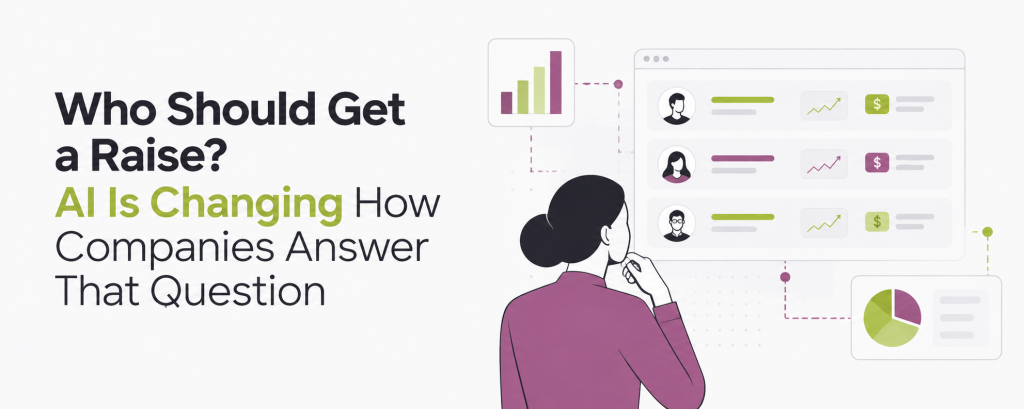
Raise season looks simple from a distance. Leadership sets a budget, managers submit recommendations, and HR turns it all into new salaries.
Up close, it’s one of the hardest allocation problems a company faces all year. A compensation team has a fixed pool of money and hundreds or thousands of individual decisions to make with it. Every dollar that goes to one person is a dollar that can’t go to someone else.
Why the old playbook struggles
For decades, companies have handled this with a familiar toolkit: salary surveys, pay bands, performance ratings, manager input, and a lot of spreadsheets. These tools still matter. They just weren’t built to handle this many variables at once.
Market rates move, sometimes faster than an annual survey cycle can capture. Two people with the same title can sit in very different places relative to what the market pays. Performance varies within every team. Some employees could leave tomorrow for a better offer, while others are comfortably positioned. And the budget is always finite.
When those factors live in separate files owned by separate people, the easiest response is to spread increases fairly evenly and hope it works out. That approach is simple to administer. It’s also a blunt way to spend money companies have very little of.
Compensation gets a closer look
The Wall Street Journal recently examined how companies are using AI and market data to make pay decisions. In “The Invisible Way Companies Are Using AI to Set Salaries,” published September 23, columnist Callum Borchers describes third-party services that offer AI salary benchmarking, pulling pay information from job postings to estimate market rates. Expanding pay-transparency laws have made that work easier.
Stello was one of the companies featured. As the Journal describes it, Stello analyzes large volumes of salary data, combining public compensation information, such as pay ranges in job listings and sources like Glassdoor, with data purchased from payroll companies. When Stello begins working with a new client, one of its first steps is assessing compensation across employees and making recommendations.
“We tell you exactly how much to pay your employees,” Stello CEO Amee Parekh told the Journal.
Parekh described one group that gets special attention: high performers who are underpaid. If a company has budget available for raises, she said, those employees should be addressed first. She noted that the growing focus on pay equity is a factor, though the reasoning is often practical. People who could earn more elsewhere are flight risks.
The same analysis also surfaces employees paid above current market rates. Parekh told the Journal she has never seen someone fired simply for being paid too much, partly because the cost of recruiting and onboarding a cheaper replacement can erase any salary savings.
Budgets are getting more selective
Stello’s approach fits a broader pattern in the WSJ’s reporting.
A Marsh survey of more than 1,000 U.S. employers found an average planned merit increase of 3.2% for 2027, within a total raise budget of 3.5%. The Conference Board’s findings were nearly identical. With that little room, companies are choosing more carefully who gets what.
Diana Scott, who leads The Conference Board’s U.S. Human Capital Center, told the Journal that employers are becoming more differentiated and intentional with their budgets, and less inclined to spread increases evenly. The Conference Board’s survey also found companies plan to reward AI skills, alongside leadership, judgment, and interpersonal abilities that are hard to replace.
Tauseef Rahman, U.S. workforce reward solutions leader at Marsh, described what this means for employees already at the top of their salary range. Their raises may be smaller, and good managers will steer the conversation toward promotion paths.
Why “high performer, biggest raise” falls short
It’s tempting to reduce raise decisions to one rule: the best performers get the most money. Consider two people who would both earn top ratings.
Employee A is a strong performer already paid well above market for her role and location. She’s valued, and her pay already reflects it.
Employee B is equally strong but paid well below market. If a recruiter called with a competitive offer, the gap would be hard to ignore.
A performance rating treats them the same. Their compensation situations are completely different. A dollar spent closing Employee B’s gap addresses a real retention risk and a possible equity issue. The same dollar added to Employee A’s pay changes much less. She may be better served by a conversation about growth, scope, or promotion, which is exactly the kind of conversation Rahman described.
Without market context, these two employees look interchangeable. With it, the smarter allocation becomes much clearer.
Two kinds of value
It helps to separate two questions that often get blended together.
The first is market value: what does the external market currently pay for this role, level, geography, and skill set? This is where AI and large compensation datasets make the biggest difference. Answering it well used to mean waiting on survey results and reconciling them by hand.
The second is individual value: what does this particular person contribute to the business? That depends on performance, potential, impact, and context that no salary dataset contains. Managers and leaders still own that answer.
Good compensation decisions need both. Better market intelligence makes the first question far easier to answer, which gives people more time to apply their judgment to the second.
Where Stello fits
Stello is built for that first layer and for connecting it to the rest of the picture. Its AI-powered compensation benchmarking and market salary intelligence show where each employee sits relative to the market. Employee-level analysis flags who appears to be below market, around it, or above it. That view supports pay equity analysis and gives compensation teams a clear read on pay positioning across the organization, without relying entirely on manual spreadsheet work.
The result is a better starting point. When market position, internal pay patterns, performance context, and retention considerations sit side by side, a compensation team can ask a sharper question: where will this budget do the most good?
What the data can’t settle
Market data is one input into a compensation decision, and an important one. It’s still only one.
Compensation also reflects performance, potential, business impact, fairness, retention strategy, and organizational priorities. Some of those resist measurement. The WSJ piece closes on this tension. Lesley Uren, CEO of Korn Ferry Consulting, told the Journal that companies are rethinking what success looks like, with one direction being to tie pay more closely to impact and outcomes and less to activity measures like hours worked. As AI changes how work gets done, defining individual value may get harder, even as market value gets easier to measure.
That’s a strong argument for keeping people firmly in charge of the final call.
The real shift
The future of compensation probably won’t be an algorithm quietly assigning everyone’s salary. The more likely version is compensation teams making sharper choices because they can finally see, employee by employee, where each person stands and where limited dollars will matter most.
Companies have always had to decide who gets a raise. What’s changing is how much they know before they decide.