Sometime this raise season, an employee will sit down with their manager and ask a question most compensation teams haven’t prepared for: did AI decide my raise?
It’s a reasonable thing to ask. Coverage of AI in pay decisions has moved from HR trade publications into mainstream personal finance. A recent Moneywise article, syndicated on Yahoo Finance, told readers that managers are increasingly using AI to decide raises, raised concerns about bias in AI tools, and offered advice on negotiating in this new environment. Among its tips: bring market data from multiple sources, and assume your boss may be using tools and data you can’t access.
Employees are being coached to walk into compensation conversations informed and a little skeptical. That shift, from pay decisions made quietly to pay decisions employees expect to be explained, is one of the clearest ways AI is changing compensation. Companies need an answer ready.
TL;DR
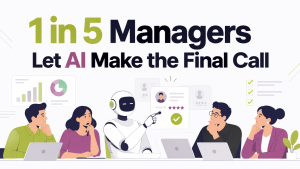
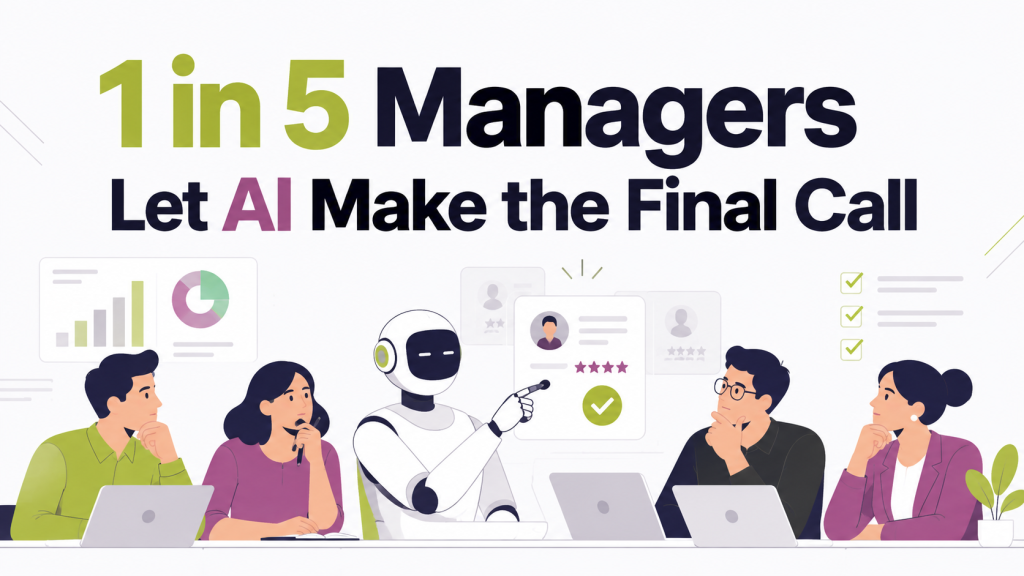
- About six in ten managers use AI to make decisions about their direct reports, and more than one in five of those say they frequently let it make final calls without human input, according to a Resume Builder survey cited by Moneywise on Yahoo Finance.
- Employees are being coached to arrive at raise conversations with their own market data, so companies need to be ready to explain how pay decisions were made.
- Stello CEO Amee Parekh told The Wall Street Journal that underpaid high performers should be the first addressed when there’s budget for raises, since people who could earn more elsewhere are flight risks.
- Above-market pay often reflects when someone was hired, and Parekh said she has never seen someone fired simply for being paid too much.
- AI-informed raises hold up only when managers can explain the data behind them and a named person approves the final number.
Why the question carries weight
The Moneywise piece drew on a Resume Builder survey of U.S. managers. About six in ten said they use AI to make decisions about their direct reports. More than one in five of those using AI said they frequently let it make final decisions without human input, and ChatGPT was the most common tool cited.
Look at that from the employee’s side of the table. If a raise came from a manager pasting details into a general-purpose chatbot, nobody can explain it well. The manager can’t say where the number came from. HR can’t defend it. The employee has good reason to distrust it.
An AI-informed raise holds up only when someone can explain how it was reached.
What “exactly” makes possible
Moneywise quoted Stello CEO Amee Parekh from The Wall Street Journal’s recent reporting on AI and pay.
“We tell you exactly how much to pay your employees,” Parekh told the Journal.
The line is easy to read as a statement about automation. For a manager preparing for a difficult conversation, it points somewhere more practical: specificity. A precise market figure built on identifiable data is something a manager can actually explain. According to the WSJ, Stello’s analysis draws on salary information from job listings and sources like Glassdoor, along with data purchased from payroll companies.
Vague numbers lead to vague conversations. Specific numbers make honest ones possible.
Parekh’s comments to the WSJ also map closely onto the three conversations managers will have most often this cycle.
Conversation one: “You were underpaid, and we fixed it”
Parekh told the Journal that underpaid high performers deserve special attention and should be the first addressed when a company has budget for raises. She pointed to the growing focus on pay equity as one reason, and to a practical one: people who could earn more elsewhere are flight risks.
This is the easiest conversation to have, and the one companies most often miss. An employee who receives a meaningful adjustment tied to a clear market gap hears two things: the company noticed, and it acted before being asked.
Compare that with the alternative Moneywise describes, where the employee researches the gap themselves and arrives ready to negotiate. By then, the company is reacting. Worse, the employee may already be talking to recruiters.
Conversation two: “Your pay is already above market”
This one is harder. Stello’s analysis also identifies employees paid above current market rates. The WSJ noted these are often people who changed jobs at an opportune moment and secured packages that today’s labor market wouldn’t support.
That detail helps managers frame the conversation fairly. Above-market pay usually reflects timing, and saying so avoids implying the employee did anything wrong.
Parekh also told the Journal she has never seen someone fired simply for being paid too much, partly because recruiting and onboarding a cheaper replacement can wipe out the savings. For the employee in the room, that context matters. A modest raise can reflect where their pay already sits, with no hidden message about their future at the company.
Moneywise advised readers in this position to come with evidence of their contributions. Managers should expect that and welcome it. It gives the employee a way to make their case, and it gives the manager information a salary benchmark can’t provide.
Conversation three: “Here’s how this was decided”
This conversation sits underneath the other two. Employees may ask about bias directly, as Moneywise suggests some will. Companies should be able to describe their process in plain language: what data informed the recommendation, who reviewed it, and who approved the final number.
Pay equity analysis belongs in that review. It gives compensation teams a way to check for patterns across groups before decisions reach employees, which is far better than discovering a problem after someone raises it.
Explaining the process doesn’t mean sharing every data point. It means a real process exists, and a named person stands behind the outcome.
Getting managers ready
The Resume Builder survey found that two-thirds of managers using AI to manage people hadn’t received formal training. That gap will show up in raise conversations first.
Preparation can be simple. Before reviews, give each manager the market position of every direct report. Make sure they can explain, in a sentence or two, why each number is what it is. Route questions they can’t answer to the compensation team, and keep figures from general chatbots out of the process entirely.
Where Stello fits
Stello gives compensation teams an employee-level view of market position, showing who sits below, around, or above market, backed by AI-powered benchmarking. It also supports pay equity analysis. The practical result is that managers walk into raise conversations with context they can stand behind. The decision itself, and the conversation that follows, still belong to people.
The raise conversation is changing
Employees are reading about AI and pay, and they’ll bring those questions to their next review. The companies that handle this well will have an answer that holds up: here’s the data we used, here’s who made the decision, and here’s why.