Your best performer just found out the person you hired three months ago is earning almost the same salary. No raise triggered it. No policy changed. It just happened, slowly, while nobody was watching.
That’s pay compression. And it is one of the quietest ways a company loses its most experienced people.
TL;DR
- Pay compression happens when tenured employees’ pay gets too close to what new hires earn, erasing the value of experience and loyalty.
- It’s getting worse in 2026 due to flat merit budgets, rising new-hire market rates, and a lack of formal job architecture.
- It rarely shows up as a clean data point. It shows up as unexplained attrition, disengaged top performers, and managers earning close to their reports.
- Spot it with a compa-ratio audit by tenure, a manager-vs-report pay check, and by comparing new offers to incumbent pay in real time.
- Fix it by ranking roles by risk, separating equity adjustments from merit raises, and reviewing salary ranges at least annually.
What Pay Compression Actually Is
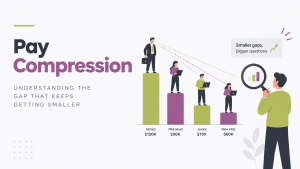
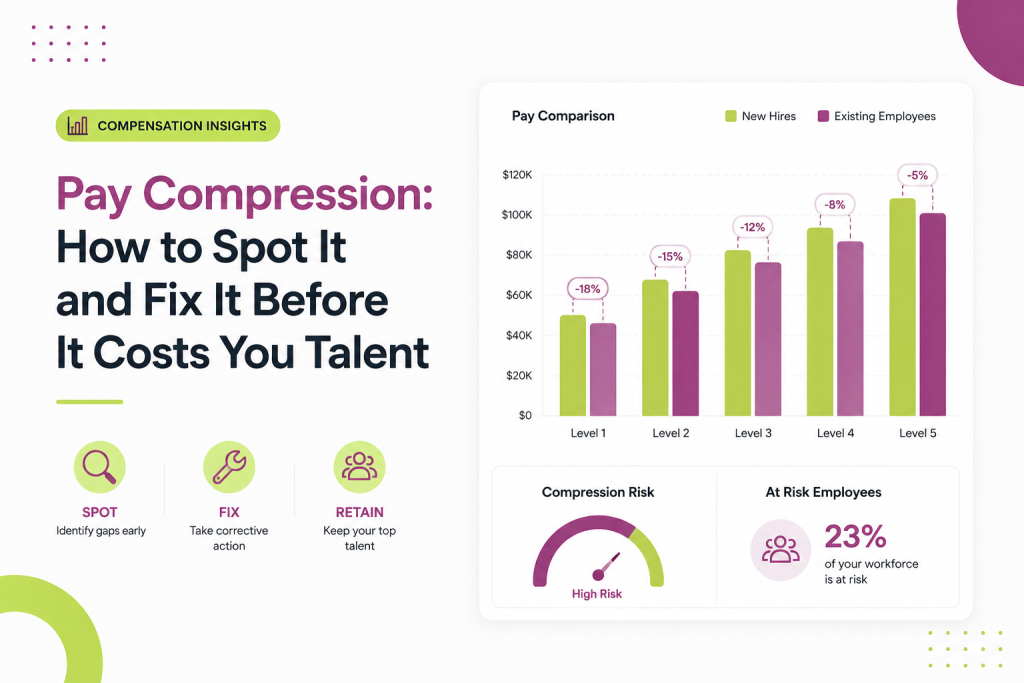
Pay compression happens when the gap between what your tenured employees earn and what new hires or less experienced peers earn shrinks to the point where experience, skill, and performance stop being reflected in the paycheck.
It shows up in two forms:
Vertical compression: A manager earns close to what their direct reports make, sometimes even less once bonuses and overtime are factored in.
Horizontal compression: A five-year employee and a five-month employee in the same role, at the same level, land within a few percentage points of each other on base pay.
Neither is a hiring mistake in isolation. Compression is what happens when hundreds of small, individually reasonable decisions, like matching a candidate’s counteroffer or keeping raises flat during a hiring freeze, stack up over time without anyone stepping back to look at the pattern.
Why It’s Getting Worse, Not Better
Pay compression isn’t a new problem, but a few forces are actively pushing it into more organizations right now.
Job-changers are out-earning job-stayers. Recent Bureau of Labor Statistics and ADP data show a persistent pay gap between people who switch jobs and people who stay put. Employees who changed jobs saw notably higher year-over-year pay growth than employees who stayed in their roles, which means every external hire brought in at market rate quietly narrows the gap with tenured staff who received smaller annual increases.
Salary budgets are flat while market rates keep moving. Multiple 2026 compensation surveys point to salary increase budgets holding in the 3.2% to 3.6% range, essentially flat compared to prior years. When merit budgets barely keep pace with inflation but starting salaries for new hires are set against current market data, the two lines are bound to converge.
Performance-based pay is widening some gaps and flattening others. In sales organizations specifically, the spread between top and average performers has grown sharply, while newer and mid-tier reps are seeing their pay bands pushed closer together. The same dynamic, rewarding a shrinking group of top performers while leaving everyone else on similar footing, is showing up well beyond sales teams.
Structural gaps make it worse. Recent research into pay practices points to a lack of formal job architecture and job leveling as a root cause behind pay confidence gaps. Without clearly defined levels and consistent range reviews, compression creeps in because there’s no structural checkpoint to catch it.
Also read: HCM vs HRIS: What’s the Difference?
The Real Cost of Ignoring It
Pay compression rarely shows up as a line item. It shows up as attrition you can’t quite explain, disengagement from your most capable people, and exit interviews where “compensation” gets checked as a reason almost as an afterthought, because by the time someone leaves, the real issue has usually curdled into something bigger: feeling undervalued.
A few compounding costs worth naming directly:
- Your best people leave first. Tenured, high-performing employees have the most market options and the least patience for feeling shortchanged relative to a new hire.
- Managers lose credibility. When a manager earns close to what their reports make, it undermines their authority and makes promotion into management look like a bad trade.
- Replacement costs eat any savings. Underpaying tenured staff to protect budget usually costs more in recruiting, onboarding, and lost productivity than a proactive adjustment would have.
- Trust erodes org-wide. Compression rarely stays a secret. Once employees start comparing notes, and pay transparency laws are making that easier every year, the perception of unfairness spreads faster than the actual pay gap does.
Also read: What is a Merit Increase? A Complete Guide
How to Spot Pay Compression Before Employees Do
Waiting for someone to flag it in a 1:1 means you’re already behind. Build the habit of checking for these signals on a regular cycle.
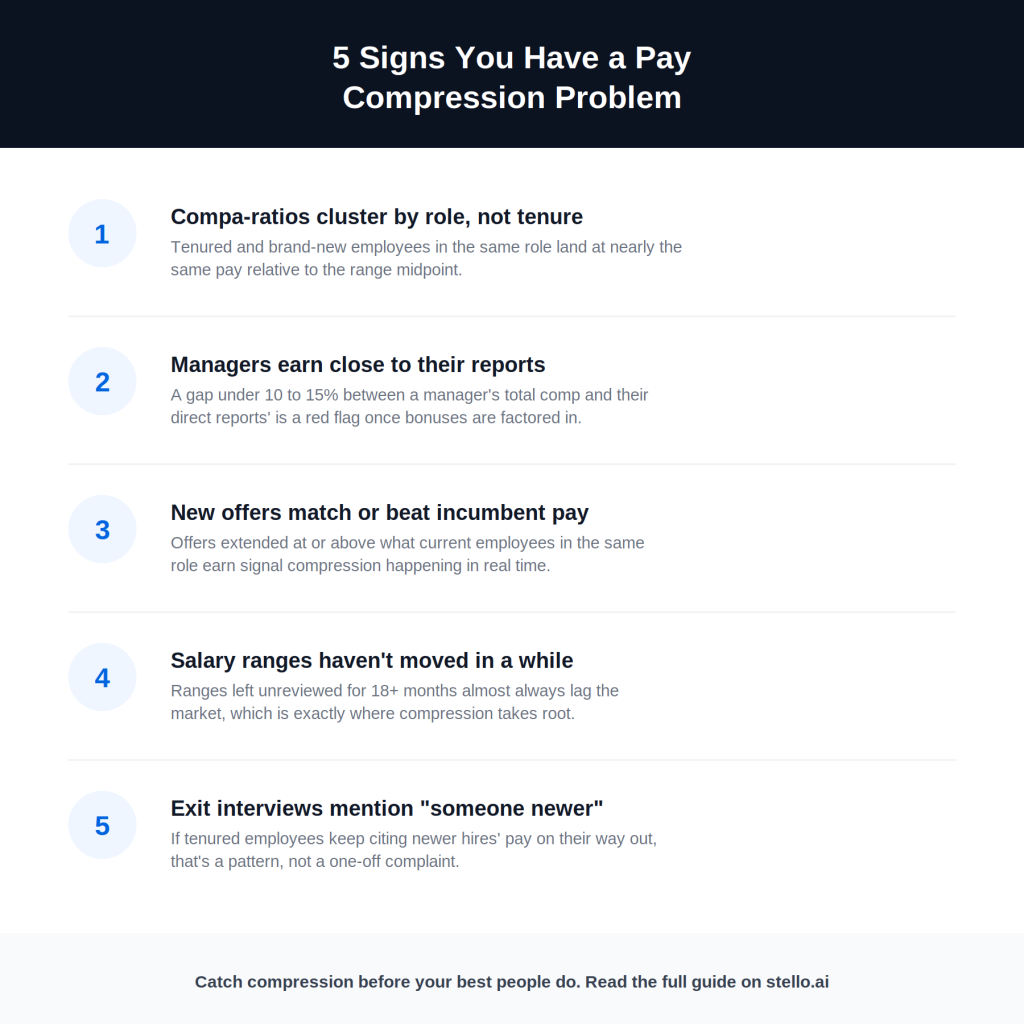
1. Run a compa-ratio audit by tenure. Pull compa-ratios (actual pay divided by range midpoint) for every role and segment by tenure within that role. If your 4+ year employees and your under-1-year employees cluster around the same compa-ratio, you have compression.
2. Check manager-to-report pay gaps. Compare every manager’s total compensation to their direct reports’. A gap under 10 to 15%, especially once bonuses are included, is a red flag worth investigating.
3. Compare new-hire offers to incumbent pay, live. Every time you extend an offer, check it against what current employees in the same role and level are earning. If the offer lands above or within a few percent of your median incumbent, that’s a compression event happening in real time, not a hypothetical one.
4. Watch your regretted attrition data. If exit interviews or stay interviews keep surfacing “someone newer makes what I make,” that’s not one disgruntled employee. That’s a pattern worth quantifying.
5. Model out your salary structure against market data annually. Pay ranges that haven’t moved in two or three years almost guarantee compression, because market rates for new hires don’t stand still even when your internal structure does.
| Signal | What to check | Warning threshold |
|---|---|---|
| Compa-ratio by tenure | Compare compa-ratios of tenured vs. new employees in the same role | Gap under 5% |
| Manager vs. report pay | Manager total comp vs. direct report total comp | Gap under 10-15% |
| New offer vs. incumbent median | Offer amount vs. median pay of current employees in role | Offer at or above incumbent median |
| Range review cadence | Time since salary structure was last benchmarked | Over 18 months |
How to Fix It
Prioritize by risk, not by budget alone. You likely can’t fix every compressed role at once. Rank roles by flight risk, business criticality, and size of the gap, then start where losing someone would hurt most.
Separate merit increases from equity adjustments. Bundling a compression fix into someone’s annual merit raise buries the real signal. Label equity adjustments as what they are, both internally in your comp planning and in the conversation with the employee, so the raise doesn’t get misread as an unusually strong performance year.
Review salary ranges at least annually. Most employers already do this, and for good reason. Ranges that lag the market by even a year create the exact gap new hires walk straight into.
Build job architecture before you scale. Clear levels and leveling criteria give you a structural way to catch compression early, instead of relying on managers to notice it anecdotally.
Communicate the “why,” not just the number. Employees don’t need to see everyone else’s pay to trust the system. They need to understand how their own pay was determined and know that the process is consistent. Recent survey data shows a real confidence gap here: HR teams tend to be far more confident in their pay fairness than employees are, and that gap has more to do with unclear communication and inconsistent job leveling than with the actual dollars.
Use compensation software to catch it continuously. Spreadsheet-based comp reviews catch compression once a year, if that. A system that flags compa-ratio drift, offer-versus-incumbent gaps, and manager-report overlaps as they happen turns this from a fire drill into routine maintenance.
The Bottom Line
Pay compression isn’t caused by one bad decision. It’s caused by dozens of reasonable ones made without visibility into the bigger picture. The fix isn’t a one-time correction, it’s building the habit of checking for it before your employees have to point it out to you.
By the time compression shows up in an exit interview, it has already cost you the trust, and often the person, you were trying to keep.
Also read: HRIS Implementation: A Step-by-Step Guide
FAQs-
What is pay compression?
Pay compression happens when the pay gap between tenured or higher-skilled employees and newer or less experienced employees shrinks so much that experience and performance stop being reflected in salary.
What causes pay compression?
It’s usually a mix of flat merit budgets, rising market rates for new hires, minimum wage increases, and salary ranges that haven’t been updated to keep pace with the market.
How do you know if you have a pay compression problem?
Run a compa-ratio audit segmented by tenure, compare manager pay to direct report pay, and check new-hire offers against what current employees in the same role earn. Small or nonexistent gaps are the warning sign.
How do you fix pay compression without blowing the budget?
Rank affected roles by flight risk and business impact, then fund equity adjustments for the highest-risk gaps first rather than trying to fix every role at once.
Is pay compression the same as pay inequity?
No. Pay inequity usually refers to unexplained gaps tied to gender, race, or other protected characteristics. Pay compression is about experience and tenure not being reflected in pay, though the two can overlap and compound each other.