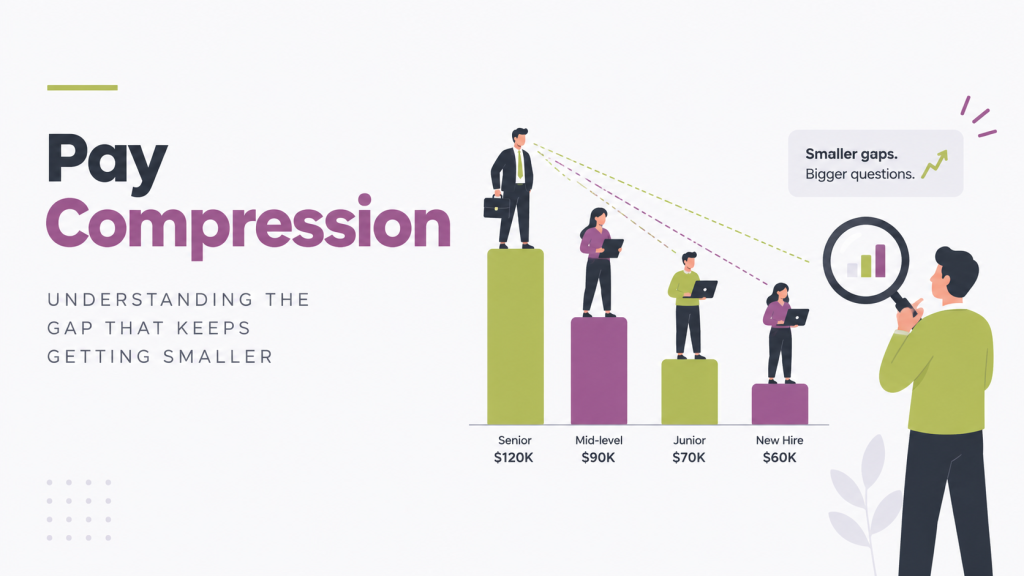
Ask a five-year employee how they’d feel about learning a new hire in the same role, doing the same work, is earning nearly what they earn — and you’ll understand why pay compression is one of the fastest ways to lose trust in a compensation program. It doesn’t show up in a single dramatic moment. It builds quietly, raise cycle after raise cycle, market adjustment after market adjustment, until one day your most tenured, highest-performing employees are earning barely more than the people they trained.
Pay compression is common, it’s usually unintentional, and it’s fixable — but only if you know where to look. This guide covers what pay compression actually is, why it happens, how to detect it before it shows up in an exit interview, and what to do once you’ve found it.
TL;DR
- Pay compression happens when the pay gap between employees at different tenure, experience, or seniority levels shrinks below what their actual value difference should be.
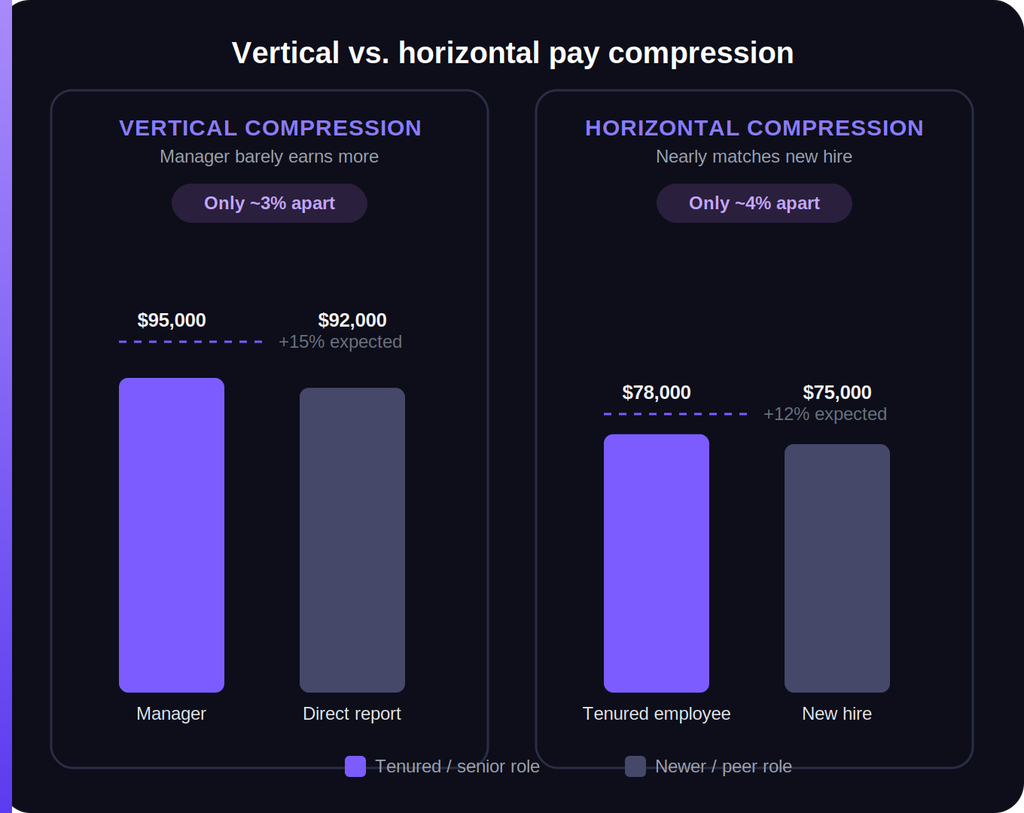
- It shows up as vertical compression (managers earning close to their direct reports) or horizontal compression (same-level employees paid nearly the same regardless of tenure).
- Main causes: market rates outpacing merit budgets, counteroffers targeting new hires, underfunded promotion increases, flat raise pools, and wide or inconsistent salary bands.
- Detect it with tenure-vs-pay analysis, manager-to-report pay ratios, and by comparing new-hire offers against internal peers before extending them.
- Fix it with targeted equity adjustments, refreshed salary bands, a separate compression-correction budget, and clear communication so raises don’t look arbitrary.
- Left unchecked, compression compounds every raise cycle — regular checks catch it at the offer stage, not the exit interview.
What is Pay Compression?
Pay compression happens when the pay gap between employees at different levels of experience, tenure, or responsibility shrinks to the point where it no longer reflects the actual difference in value, skill, or seniority between them.
It typically shows up in two forms:
Vertical compression — the gap between a manager’s salary and their direct reports’ salaries narrows or disappears. A manager earning $95,000 supervising a senior engineer earning $92,000 is a vertical compression problem, especially if the manager took on the role for growth, not a pay bump.
Horizontal compression — employees at the same level, but with meaningfully different tenure or performance, end up paid within a few percentage points of each other. A five-year employee earning $78,000 next to a new hire brought in at $75,000 for the identical role is horizontal compression.
Neither form is inherently a policy failure. It’s usually the accumulated side effect of decisions that made sense individually but never added up to a coherent whole.
Also read: What is Pay Transparency? A Complete Guide for US Employees and Employers
Why Pay Compression Happens
Pay compression rarely results from one bad decision. It’s what happens when several ordinary, well-intentioned compensation practices run in parallel without anyone checking how they interact.
1. Market rates rise faster than internal raises
Salary benchmarks for a given role can move 8–15% year over year in a tight labor market. If your annual merit increase budget is capped at 3–4%, new hires brought in at current market rate will consistently land close to — or above — what tenured employees are earning, even when merit increases have been applied every single year.
2. Counteroffers and retention raises target new joiners
When a company loses a candidate to a competing offer and raises the starting salary to win them back, that adjustment is made against the external market, not against the internal pay structure. Repeat this enough times across enough roles, and the org’s newest employees quietly become its best-paid ones at that level.
3. Promotions without matching pay adjustments
A common but underweighted cause: employees get promoted into management or senior roles, but the salary increase attached to the promotion is modest — often 5–10% — because the increase is capped by internal guidelines rather than benchmarked against what the new role is actually worth in the market. Do this consistently and your manager layer compresses against the individual contributors below it.
4. Flat or capped raise pools during high inflation or hiring booms
When merit budgets stay flat while the labor market is volatile, the only lever that moves with the market is the offer given to new hires. Existing employees’ pay effectively falls behind in real terms every cycle the budget doesn’t keep pace.
5. Inconsistent use of salary bands
If bands are wide, or if hiring managers routinely bring people in at the top of a band regardless of experience, tenured employees who started at the bottom of the same band years ago never catch up — even with regular increases — because the raises are calculated as a percentage of an already-lower base.
6. Mergers, acquisitions, and system migrations
Combining two companies’ pay structures, or migrating from one HRIS/comp platform to another, frequently surfaces — or creates — compression that no one intended, because two independently reasonable pay philosophies rarely align perfectly when merged.
None of these causes require anyone acting in bad faith. That’s exactly why compression is dangerous: it accumulates silently inside processes that all look fine in isolation.
Also read: Equity Compensation Planning: A Guide for HR and Comp Teams
How to Detect Pay Compression
Compression is hard to spot by looking at any single employee’s pay. It only becomes visible when you compare people against each other, against the market, and against time. Here’s a practical detection sequence.
1. Run a tenure-vs-pay analysis by role and level
For every job level, plot current base salary against tenure in role. In a healthy structure, you should see pay generally trending upward with tenure (accounting for performance). A flat or inverted trend line — where newer employees cluster near or above longer-tenured ones — is the clearest compression signal you can find.
2. Check manager-to-direct-report pay ratios
For every manager, calculate the gap between their pay and the highest-paid person on their team. A healthy gap is typically 10–20%, though this varies by function and level. Ratios under 5%, or negative ratios where a direct report out-earns their manager, should be flagged for review.
3. Compare new-hire offers to internal peer pay, role by role
Every time an offer is extended, check it against the pay of existing employees in the same role and level. This is the single highest-leverage detection point, because it catches compression at the moment it’s created — before it compounds across multiple hiring cycles.
4. Benchmark against external market data regularly
Compression often reflects a market that has moved faster than your internal structure. Refreshing market data annually (or more often in volatile roles like engineering and sales) tells you whether your bands themselves have fallen behind, which is a leading indicator of compression even before it shows up between individual employees.
5. Segment by demographic group
Because compression accumulates through repeated small decisions, it can disproportionately affect groups who are promoted less frequently, negotiate less often, or were hired further from a market peak. A compression analysis cut by gender, race, or hire cohort can reveal equity issues layered on top of the structural ones — worth reviewing alongside, not instead of, a standard pay equity audit.
6. Ask your managers
Data catches structural compression. Managers catch the human version — an employee who’s mentioned feeling undervalued, or a manager who’s noticed a new hire’s offer letter. Build a lightweight way for managers to flag pay concerns into your comp review process; they’ll often surface problems before the numbers do.
Also read: What are Salary Bands? Definition, Examples, and How to Create Them
How to Fix Pay Compression
Once you’ve found compression, the fix depends on how widespread it is and how much budget you have to correct it. Most organizations use some combination of the following.
1. Targeted equity adjustments
Rather than raising everyone, identify the specific employees whose pay has fallen out of line relative to peers and tenure, and adjust those individuals directly. This is the most budget-efficient fix and the one most comp teams reach for first, because it targets the actual problem rather than spreading a limited budget across the whole population.
2. Rebuild or widen salary bands around current market data
If compression stems from bands that have gone stale, refreshing the bands themselves — not just individual salaries — prevents the same compression from recurring next cycle. This is slower but addresses the root cause rather than the symptom.
3. Separate a compression-correction budget from the merit budget
Folding compression fixes into the standard annual merit pool guarantees they’ll compete with performance-based raises and lose. Many comp teams now request a distinct budget line specifically for structural pay corrections, reviewed on its own cycle rather than at merit time.
4. Adjust promotion increase guidelines
If promotions are consistently underpaid relative to market value for the new role, revisit the increase percentage guidelines tied to promotions — ideally benchmarking the new role’s market rate directly rather than applying a flat percentage bump to the old salary.
5. Tighten new-hire offer governance
Require that new-hire offers above a certain percentile, or above existing team members’ pay, get a compression check before the offer goes out. This is a small process change that prevents a large share of future compression before it’s created.
6. Communicate the fix, not just the number
When compression adjustments are made, employees often notice the raise but not the reasoning — which can look like an arbitrary bonus rather than a structural correction. Where appropriate, let managers explain that an adjustment was made to correct a pay structure issue, not tied to a performance conversation. This preserves trust in the process itself, which is often what compression damages most.
The Real Cost of Letting It Sit
Pay compression is rarely fixed by accident — the same forces that create it (external market pressure, flat budgets, promotion timing) don’t self-correct without deliberate intervention. Left unaddressed, it tends to compound: tenured, high-performing employees start next raise cycle already behind, and the gap that should reward their experience keeps shrinking instead.
The organizations that manage compression well aren’t the ones with unlimited comp budgets. They’re the ones that check for it regularly, catch it at the offer stage rather than the exit interview, and treat it as a structural maintenance issue rather than a one-time cleanup project.
Running this kind of analysis manually across every role, level, and hire cohort is exactly the kind of work that scales poorly with spreadsheets — and exactly where a compensation platform that can model pay ratios, flag offers against internal peers, and run tenure-vs-pay analysis automatically saves comp teams from finding compression the hard way.