Pay equity is no longer a nice-to-have. Between tightening pay transparency laws, rising employee expectations, and the reputational risk of getting it wrong, more companies are moving pay equity analysis from an occasional legal exercise to a recurring business practice.
But “conduct a pay equity analysis” is easier said than done. It touches HR, legal, finance, and data teams all at once, and a rushed or poorly scoped analysis can create more questions than it answers. This guide breaks the process into a clear, repeatable framework you can use whether this is your first pay equity analysis or your fifth.
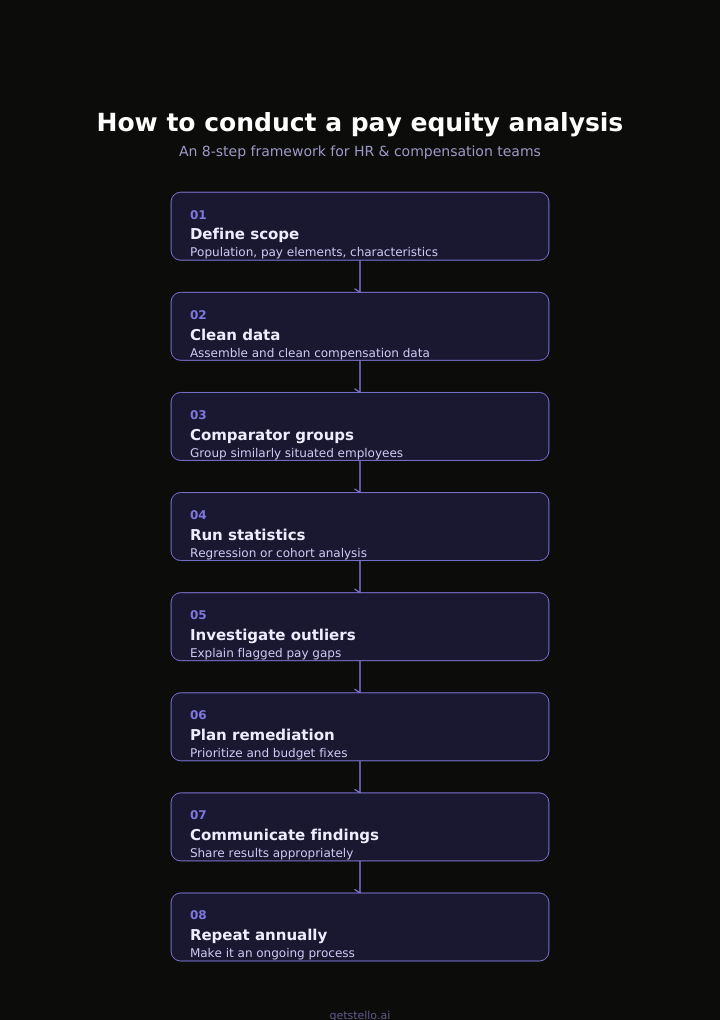
TL;DR: How to Conduct a Pay Equity Analysis
- Define scope — decide which employees, pay elements, and protected characteristics you’re analyzing, and whether it’s under legal privilege.
- Clean your data — gather demographics, job codes, levels, and pay data; fix inconsistencies before analyzing (this takes the most time).
- Build comparator groups — group employees doing similar work at similar levels, ideally using job family + level rather than exact titles.
- Run the statistics — use regression analysis (or cohort/mean analysis for smaller teams) to spot pay gaps unexplained by legitimate factors.
- Investigate outliers — dig into flagged cases individually and document your findings, even when no action is taken.
- Plan remediation — budget for fixes before sharing results; prioritize the most significant, hardest-to-justify gaps first.
- Communicate carefully — align messaging with your legal posture, whether that’s internal-only or public disclosure.
- Repeat annually — treat pay equity as an ongoing process, not a one-time audit, with checks at hiring, promotion, and reorg points.
What is a Pay Equity Analysis?
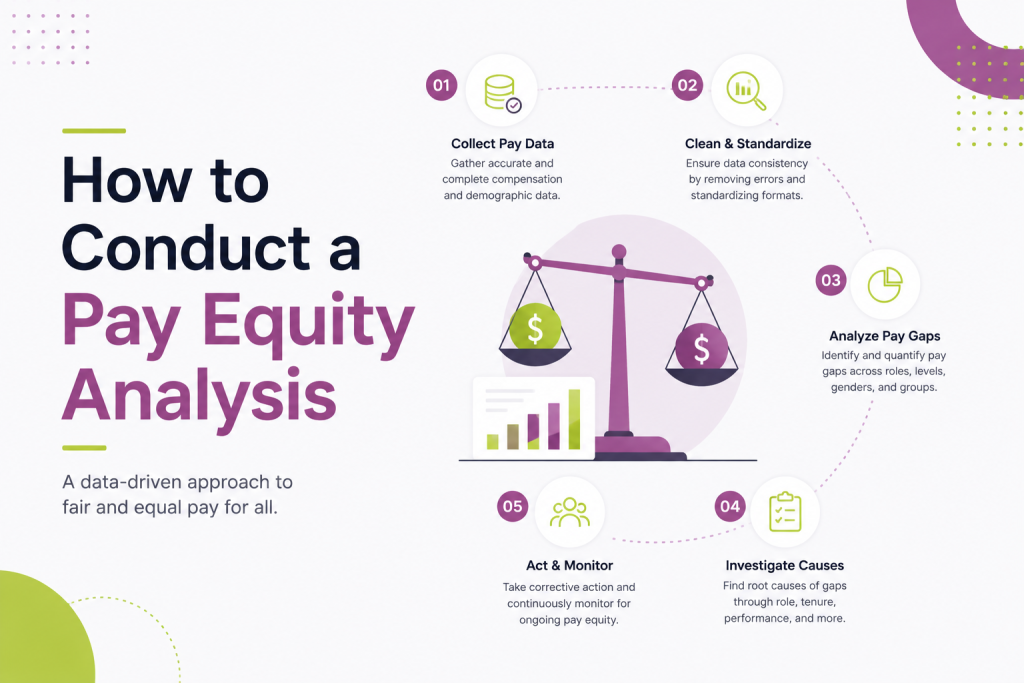
A pay equity analysis is a systematic review of compensation data to determine whether employees are being paid fairly for comparable work, after accounting for legitimate factors like experience, performance, and role. The goal is to identify unexplained pay gaps — differences in pay that correlate with characteristics like gender, race, or age rather than job-related factors — and to fix them before they become legal, financial, or cultural liabilities.
It’s different from a general compensation review, which looks at whether pay is competitive externally. A pay equity analysis looks internally: are people doing similar work, at similar levels, being paid similarly — regardless of who they are?
Step 1: Define the Scope and Objective
Before touching any data, decide what you’re actually analyzing. Scope decisions shape everything downstream, so get this right first.
Questions to answer:
- Which employee population? All employees, or a specific business unit, country, or job family? Multinational companies often need separate analyses per country due to differing legal definitions of pay.
- Which pay elements? Base salary is the minimum. A thorough analysis also includes bonuses, commissions, equity, and sometimes total cash compensation.
- Which protected characteristics? Gender is the most common starting point, but race/ethnicity, age, and disability status are increasingly included, depending on jurisdiction and available data.
- Privileged or non-privileged? Many organizations conduct this analysis under attorney-client privilege, especially in the U.S., to protect findings from discovery in litigation. Decide this with legal counsel upfront — not after you’ve found a problem.
Write the scope down. It becomes your reference point when stakeholders later ask “why didn’t we look at X?”
Also read: AI Comp Management for Startups: What’s Different Under 200 Employees
Step 2: Assemble and Clean Your Data
Pay equity analysis is only as good as the data behind it. This step usually takes longer than people expect — often 60–70% of total project time.
Core data points you’ll typically need:
- Employee demographics (gender, race/ethnicity, date of birth, etc.)
- Job title, job code, and job family
- Level or grade
- Department and manager
- Location (city, state, country)
- Hire date and tenure
- Base pay, bonus target and actual, equity grants
- Performance ratings (recent and, ideally, historical)
- Full-time/part-time and exempt/non-exempt status
Common data quality issues to resolve before analysis:
- Inconsistent job titles that don’t map cleanly to job codes
- Missing or outdated demographic data
- Pay data that mixes annualized and actual amounts
- Employees miscategorized in job families
- Outliers from recent promotions, transfers, or acquisitions
Clean, well-structured data prevents false positives (and false negatives) later. This is also where having a centralized people analytics system pays off — pulling data from five disconnected spreadsheets versus one clean source can be the difference between a two-week project and a two-month one.
Also read: 7 Tasks an AI Compensation Agent Can Take Off Your Plate This Year
Step 3: Build Comparator Groups (Similarly Situated Employees)
You can’t compare a first-year analyst’s pay to a VP’s pay and draw meaningful conclusions. The next step is grouping employees who are “similarly situated” — doing comparable work at a comparable level.
Common ways to build comparator groups:
- Job title/job code grouping: Simple but risky if titles are inconsistent or inflated.
- Job family + level grouping: More robust; groups employees by function (e.g., “Software Engineering”) and level (e.g., “Mid-level”) rather than exact title.
- Statistical/regression-based grouping: Uses multiple factors simultaneously (job family, level, location, tenure, performance) to model expected pay, rather than manually bucketing employees.
Most mature pay equity analyses use a regression-based approach because it can control for multiple legitimate pay factors at once and produces a defensible, quantifiable result — rather than relying on the boundaries of manually defined groups.
Step 4: Choose and Run the Statistical Methodology
This is the technical core of the analysis. Two approaches dominate:
1. Cohort/mean analysis Compare average pay within each comparator group by protected characteristic (e.g., average pay for women vs. men within “Mid-level Software Engineers”). Simple to explain, but less rigorous — it doesn’t control for other legitimate factors within the group.
2. Multiple regression analysis The industry standard for organizations with enough headcount (typically 30+ employees per group). A regression model predicts expected pay based on legitimate factors — level, tenure, performance, location, job family — and then measures whether protected characteristics (gender, race, etc.) still show a statistically significant relationship with pay after controlling for those factors.
If regression flags a statistically significant gap, that doesn’t automatically mean discrimination — it means there’s a pattern that isn’t explained by the factors in your model, and it’s worth investigating individually.
Smaller companies without enough headcount for regression often rely on the cohort method, or supplement it with structured manager review of individual cases.
Step 5: Investigate and Document Outliers
Once the model flags gaps, the next step is understanding why. This is where automated analysis ends and human judgment begins.
For each flagged employee or group:
- Review their history — recent hire vs. long tenure, internal transfer, unique skill set, market premium hire, etc.
- Check if a legitimate factor was simply missing from the model (e.g., a niche certification or specialized skill not captured in the data)
- Distinguish between individual anomalies and systemic patterns affecting a whole group
Document your findings and rationale for every case, even ones you decide not to remediate. This documentation is critical both for legal defensibility and for consistency — if you can’t explain a gap in writing, it’s hard to defend it in an audit or lawsuit.
Step 6: Determine and Prioritize Remediation
Not every gap gets fixed in the same pay cycle — but every unexplained gap needs a plan.
Typical remediation approaches:
- Immediate off-cycle adjustments for the most significant, hardest-to-justify gaps
- Phased adjustments spread across 1–2 review cycles for budget reasons
- Bundling adjustments into the next annual comp cycle, clearly flagged as equity-driven rather than merit-driven
Budget for remediation before you present findings to leadership — companies that run the analysis without a remediation budget often end up sitting on findings they can’t act on, which creates its own legal and cultural risk.
Also read: AI Comp Management for Startups: What’s Different Under 200 Employees
Step 7: Communicate Findings — Carefully
How you communicate results depends heavily on your legal posture and privilege decisions from Step 1.
- If conducted under privilege, findings are typically shared only with legal, HR leadership, and relevant executives — not broadly.
- If conducted for public transparency (e.g., annual pay equity reports, part of ESG disclosures), findings may be summarized publicly, often at an aggregate level, without exposing individual cases.
- Internally, many companies now proactively communicate their commitment to pay equity and the existence of a regular review process, even without disclosing specific figures.
Whatever the approach, consistency matters. Employees increasingly expect companies to be able to speak to their pay equity practices, even informally.
Step 8: Make It a Recurring Process, Not a One-Time Project
The organizations that get the most value from pay equity analysis treat it as an ongoing discipline rather than a one-time audit:
- Run a full analysis at least annually
- Re-check pay equity at key trigger points: after acquisitions, major reorgs, or large hiring pushes
- Build pay equity checks into the promotion and offer-approval process, so new gaps are caught before they’re created rather than after
- Track the same metrics over time to show trend direction to leadership and, where relevant, the board
Final Thoughts
A pay equity analysis is as much a data and process discipline as it is a legal or HR exercise. The companies that do it well don’t just run a one-off statistical test — they build a repeatable framework: clean data, sound methodology, documented judgment calls, funded remediation, and a plan to do it again next year.
Done consistently, pay equity analysis stops being a compliance checkbox and becomes a genuine trust-building tool — with employees, with regulators, and with the market.