Pay equity audits used to be a once-a-year fire drill. Someone in HR would export a spreadsheet, someone in finance would run some formulas, and everyone would hope the numbers looked defensible before the board meeting or the compliance deadline.
That approach doesn’t hold up anymore. Pay transparency laws are expanding, employees are comparing notes more openly, and regulators are asking for documentation, not just good intentions. A pay equity audit needs to be a workflow, not an event. And AI is what makes that shift practical.
Here’s how to actually build one.
TL;DR
- Annual pay equity audits are point-in-time snapshots. AI enables continuous monitoring instead, catching gaps as they form.
- Start with data centralization and clean job architecture. AI analysis is only as good as the comp and role data behind it.
- Use regression analysis, not simple averages, so you’re isolating the unexplained pay gap after controlling for tenure, performance, and role.
- Set threshold alerts (commonly 3-5%) so new hires and off-cycle raises get flagged before they’re finalized, not after.
- Build a documented review trail for every flag. That trail is what actually holds up if pay practices are ever challenged.
Why annual audits aren’t enough
A single audit tells you where you stood on the day you ran it. It says nothing about what happened the week after, when three new hires came in above the median or a manager approved an off-cycle raise that quietly widened a gap.
Pay equity drifts constantly. New hires, promotions, market adjustments, and manager discretion all touch compensation in real time. If your audit process only runs once a year, you’re always looking at a snapshot that’s already out of date.
An AI-driven workflow flips this. Instead of a periodic check, you get continuous monitoring that flags issues as they emerge, before they compound into a pattern you have to explain later.
Also read: AI-Driven Pay Equity Audit: How AI Is Transforming Compensation Fairness
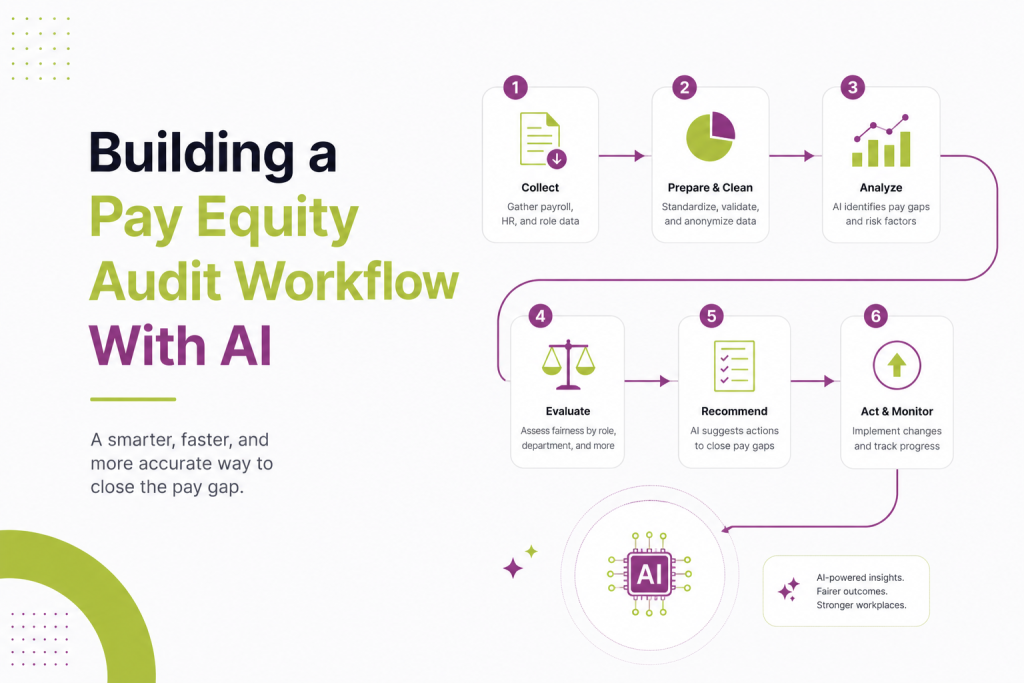
What the workflow actually looks like
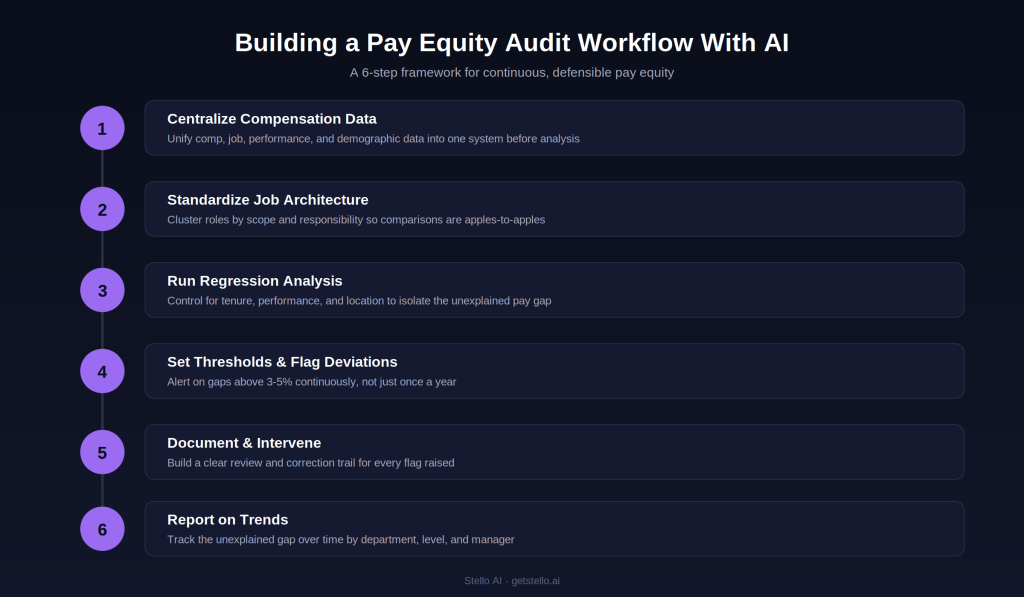
1. Centralize your compensation data
AI can’t analyze what it can’t see. The first step is getting comp data, job architecture, performance ratings, and demographic data into one system instead of scattered across HRIS exports, spreadsheets, and offer letters.
This is less glamorous than the AI part, but it’s where most audits actually fail. Inconsistent job titles, missing levels, or incomplete demographic fields will quietly wreck your analysis before a single model runs.
2. Standardize job architecture first
Pay equity comparisons only mean something when you’re comparing people doing similar work. AI models can help cluster roles by responsibilities, skills, and scope, which is especially useful if your job titles have grown organically and no longer map cleanly to levels.
Get this structure right before you run any statistical analysis. Comparing a “Senior Analyst” in one department to a “Senior Analyst” in another only works if those titles actually mean the same thing.
3. Run regression analysis, not just averages
Simple average-based comparisons (what men make versus what women make, for example) are a starting point, but they miss confounding variables like tenure, performance, location, and role complexity.
AI-powered regression models control for these legitimate factors automatically, so what’s left is the unexplained gap, the part that isn’t accounted for by job-relevant differences. That unexplained gap is what regulators, auditors, and your own leadership actually care about.
4. Set thresholds and let the system flag deviations continuously
Once the model is trained on your data, the real value comes from ongoing monitoring. Set a threshold, say, any unexplained gap above 3-5%, and let the system flag it automatically whenever new comp decisions are entered.
This turns pay equity from a backward-looking report into a forward-looking guardrail. A manager proposing an off-cycle raise that would push someone outside the equitable range gets flagged before the raise is finalized, not six months later in an audit.
5. Build an intervention and documentation trail
Flagging a gap is only half the workflow. You need a clear process for what happens next: who reviews the flag, what correction options exist, and how the decision gets documented.
This documentation matters more than most teams realize. If you’re ever asked to justify your pay practices, whether by an employee, a regulator, or a plaintiff’s attorney, a documented review trail is far stronger than “we looked into it and it seemed fine.”
6. Report on trends, not just point-in-time snapshots
AI tools can track how your unexplained pay gap moves over time, by department, by level, by manager. This is where patterns show up that a single audit would miss entirely, like one department consistently having wider gaps than others, or gaps that reopen every promotion cycle.
Trend reporting is also what turns pay equity work into a credible story for leadership. “Our unexplained gap has narrowed from 4.2% to 1.8% over six quarters” is a much stronger update than a single static number.
Also read: Human vs. AI: Who Should Make Compensation Decisions?
Common mistakes to avoid
Treating the AI model as a black box. If you can’t explain why the model flagged something, you can’t act on it credibly, and you definitely can’t defend it externally. Choose tools that show their work, not just their conclusions.
Skipping the job architecture step. No model can fix bad job leveling. Garbage structure in, garbage comparisons out.
Auditing compensation without auditing the process around it. A clean regression result doesn’t mean your comp process is fair if managers have wide discretion with no guardrails. The workflow needs to catch issues at the point of decision, not just after the fact.
Making it a compliance-only exercise. Pay equity work lands better internally when it’s framed as part of building trust with employees, not just checking a legal box. The teams that get the most value treat it as an ongoing commitment, not a defensive posture.
Also read: How AI Compensation Agents Change the Comp Analyst’s Job (Not Replace It)
What good looks like
A mature AI-driven pay equity workflow runs quietly in the background. New hires get benchmarked against equitable ranges before an offer goes out. Off-cycle raises get checked against the model before they’re approved. Quarterly trend reports go to leadership as a matter of course, not as a scramble before an audit deadline.
By the time an external audit or a transparency law requires you to report your numbers, you already know what they are. That’s the real shift AI enables here: not just faster analysis, but a compensation process that stays equitable by design instead of getting corrected after the fact.
If you’re just starting to build this out, start with the data centralization and job architecture steps. They’re unglamorous, but they’re the foundation everything else depends on. The AI analysis is only as good as what you feed it.
FAQs-
What’s the difference between a pay equity audit and pay equity monitoring?
An audit is a point-in-time check, usually annual. Monitoring is continuous, using AI to flag unexplained pay gaps as new comp decisions happen, not just once a year.
How much unexplained pay gap is considered a red flag?
There’s no universal legal threshold, but most organizations set internal alerts around 3-5%. Anything above that gets flagged for review, though the right number depends on your industry, company size, and risk tolerance.
Do we need clean job architecture before running an AI pay equity analysis?
Yes. Comparisons only mean something when you’re comparing people doing similar work. If job titles and levels are inconsistent, the analysis will produce misleading results no matter how good the model is.
Can AI pay equity tools account for legitimate factors like tenure and performance?
Yes, that’s the point of regression-based analysis over simple averages. The model controls for job-relevant variables like tenure, performance, and location, isolating the gap that isn’t explained by those factors.
Is documentation from an AI audit tool enough to defend against a pay equity claim?
It helps significantly, but documentation quality matters more than the tool itself. A clear trail showing what was flagged, who reviewed it, and what action was taken is what actually holds up, whether the review was AI-assisted or manual.