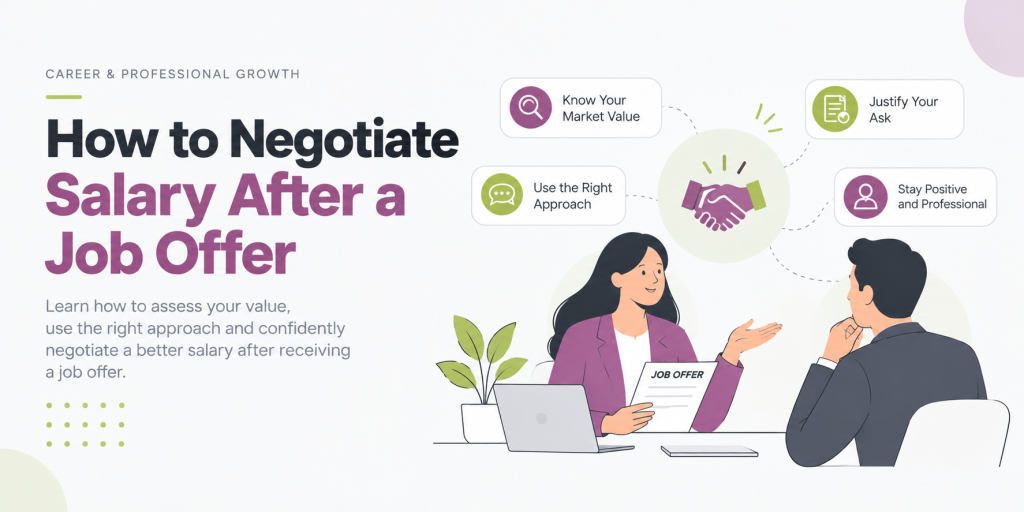
To negotiate salary after a job offer, thank the employer, ask for a day or two to review it, then reply with a specific counteroffer backed by market data and your experience. Keep it polite and focused on value.
Most employers expect it, and a well-reasoned ask rarely puts an offer at risk.
Why the Job Offer Is the Best Time to Negotiate
Once you have an offer, the company has already spent weeks interviewing and has decided it wants you. Replacing you with the next candidate costs time and money. That’s when your leverage is highest.
Most people who ask, get something. In a Pew Research Center survey, 69% of men and 62% of women who asked for more pay than the initial offer received more.
How to Negotiate a Salary Offer, Step by Step
Step 1: Thank them and ask for time
You don’t need to answer on the spot. Try: “Thank you, I’m really excited about this role. Could I have until Thursday to review the full offer?” One to three business days is normal.
Step 2: Review the full offer
Look beyond base salary. Check the bonus target, equity, signing bonus, benefits, retirement match, paid time off, start date and remote work policy. Something other than base pay may be easier for the company to move on.
Step 3: Compare it with the market
Check what the role pays for your level and location. Use the pay range in the job posting if there was one, plus Bureau of Labor Statistics data and salary sites. If the offer sits near the bottom of the posted
range and you meet every requirement, you have a clear case.
Step 4: Decide on your counteroffer
Choose one specific number. Many people ask for 5% to 10% above the initial offer, staying within the posted range if one was shared. Also decide your walk-away point before the conversation.
Step 5: Make the ask
A call is usually best for the ask itself. Keep it short:
“Thank you again for the offer. I’m excited about the role and the team. Based on the market rate for this position and my experience leading similar projects, I was hoping for a base salary of $98,000. Is there flexibility to get there?”
Then stop and listen.
Step 6: Respond to their answer
If they say yes, thank them and ask for an updated offer letter. If they meet you partway, decide whether it works for you, or ask about other parts of the package. If they say no, you can still ask: “I understand.
Would there be flexibility on a signing bonus or an earlier salary review?”
Step 7: Get it in writing
Don’t resign from your current job until you have the final offer in writing.
How Do You Negotiate Salary for a New Job When the Range Is Posted?
When the job posting includes a pay range, use it. Most employers hire new staff between the minimum and the midpoint, and save the upper half for people with more experience. If you exceed the requirements, it’s reasonable to ask for the midpoint or above. Asking for more than the maximum usually doesn’t work unless the role is changing.
Can You Lose a Job Offer by Negotiating Salary?
It’s rare, but it can happen. Offers are usually withdrawn because of how the candidate negotiated, not because they asked. Common triggers include:
- Demanding a number far above the posted range or market rate
- Issuing ultimatums or taking an aggressive tone
- Inventing a competing offer
- Going back and forth for weeks without a decision
A polite, well-supported ask is part of a normal hiring process.
What to Negotiate If Base Salary Won’t Move
| If base salary is fixed, ask about | Why it helps |
| Signing bonus | One-time cost, often easier to approve |
| Bonus target | Raises total pay without changing the salary range |
| Equity | Valuable at growing companies |
| Salary review in 6 months | Gives you a path to a raise based on performance |
| Extra paid time off | Low cost to the employer |
| Remote or hybrid work | Saves commuting time and costs |
| Later start date | Time to rest, or to collect a bonus from your current job |
For Employers: How to Handle Salary Offer Negotiations
When candidates negotiate, hiring managers are often under pressure to say yes quickly. The risk is an offer that pays a new hire more than people already doing the same job. That pay compression usually comes to light within months.
Set rules before offers go out: where new hires usually land in the range, who can approve offers above the midpoint, and what other parts of the package recruiters can offer. Stello AI’s AI compensation agent, Iconic, builds offers from market data and checks each one against the team median, band midpoint and gender pay gap. Recruiters can see whether a counteroffer still fits before they agree to it. See how Iconic builds offers.
Frequently Asked Questions
How do I negotiate a salary offer?
Thank the employer, ask for a day or two to review, research the market rate, then reply with a specific number and a short reason based on your experience.
How much should I counter a salary offer?
Many candidates counter at 5% to 10% above the initial offer. If the job posting showed a pay range, stay inside it.
Is it OK to negotiate salary after accepting a job offer?
It’s best to negotiate before you accept. Once you’ve accepted, the employer will usually treat the terms as agreed.
Can I negotiate salary over email?
Yes. Email works well if a call isn’t possible, and it’s useful to confirm what you agreed on a call. See our salary negotiation email templates.
What if the employer says no to my counteroffer?
Thank them, then ask about other parts of the offer, such as a signing bonus, extra time off or an earlier salary review.