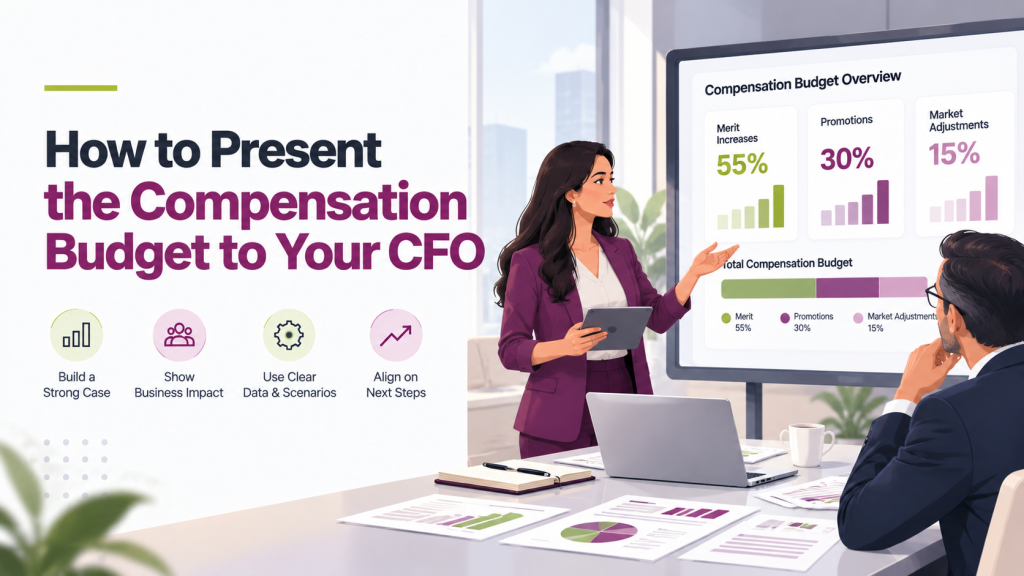
Show your CFO the full cost of the compensation budget, not just the raise percentage. Include payroll taxes, benefits and the effective date. Back the number with market data, give two or three scenarios, and show what doing too little would cost in turnover. CFOs approve budgets they can model, not percentages they have to take on trust.
H2: What Your CFO Wants From the Compensation Budget
Your CFO is looking at the compensation budget alongside every other request competing for the same money. In practice, they want five answers:
- What it costs this fiscal year and on a full-year basis.
- Why this number and not a lower one.
- What happens if they approve less.
- How the money will be split.
- How you’ll make sure managers stay inside it.
Build your presentation around those five questions and you’ll spend less time defending the numbers.
H2: Step 1: Show the Real Cost
A 3.5% salary increase budget costs more than 3.5% of base payroll, and usually less than that in the first year. Show both numbers.
Take a company with a $40M base payroll:
| Line | Amount |
| 3.5% salary increase budget | $1,400,000 |
| Payroll taxes and pay-linked benefits (example: 10% load) | $140,000 |
| Full-year cost | $1,540,000 |
| Cost this fiscal year if raises start April 1 (9 of 12 months) | $1,155,000 |
The 10% load is an example. Ask your finance team for the rate they use. Effective date matters a lot: a raise that starts April 1 costs only 75% of its annual amount in a calendar fiscal year, but the full amount every year after.
H2: Step 2: Back the Number With Market Data
The CFO’s first question is usually “What’s everyone else doing?” Answer it before it’s asked. For 2027, the major US surveys put total salary increase budgets between 3.4% and 3.6%, and merit budgets near 3.2% (WTW, Mercer, WorldatWork). See [2027 Salary Increase Budgets] for the full comparison.
Then show your own position. National averages matter less than where your people sit:
- What share of employees are below their band midpoint?
- Which critical roles are furthest behind the market?
- Is your industry above or below the average? (Mercer has high tech at 3.8% and retail at 3.0% for 2027.)
H2: Step 3: Give Scenarios, Not One Number
A single number invites a yes or a no. Scenarios start a conversation about trade-offs. Present three:
| Scenario | Budget | Full-year cost | What it buys |
| Hold | 3.2% | $1,408,000 | Matches the merit market. Little room to reward top performers. |
| Recommended | 3.5% plus 0.5% market adjustments | $1,760,000 | Market-level merit plus fixes for the roles most at risk. |
| Stretch | 4.0% plus 0.5% market adjustments | $1,980,000 | Real differentiation for top performers. |
Costs use the $40M payroll and 10% load from Step 1.
Make sure each scenario says what you can and can’t do with it. “At 3.2%, a top performer gets about 4.5% and a solid performer gets about 3%” is easier to judge than “3.2%”.
H2: Step 4: Show the Cost of Doing Too Little
CFOs see the budget as a cost. Show them the cost on the other side. Pick the roles where pay is furthest below market and estimate what it would cost to replace one person in each: recruiting fees, time to fill, lost output and ramp-up time. Use your own data where you have it, especially recent exits that gave pay as the reason.
One example from your own company is worth more than any industry statistic. “We lost two senior engineers last year who each left for 15% more. Replacing them cost $X and took Y months.”
H2: Step 5: Split the Compensation Budget Into Clear Pools
Show how the money will be divided: merit, promotions and market adjustments. Separate pools tell finance what each part of the money is for and make overspend in one area easy to spot. [Separate Budgets for Merit, Promotions and Market Adjustments] explains how to size each one.
H2: Step 6: Explain How You’ll Keep Managers Within Budget
Finance wants to know the number will hold once 40 managers start making decisions. Explain the controls: budget limits per manager, guidelines from a merit matrix, approval steps for anything above guideline, and how you’ll report spend during the cycle.
In Stello, budgets update in real time as managers plan, so HR and finance can see how much is allocated at any point in the cycle. Before the meeting, ask Iconic to model your scenarios. A question like “What does our merit budget look like at 3.5% compared with 4%?” returns the cost split by department in seconds.
H2: A Simple Compensation Budget Presentation Outline
Keep it to six slides:
- The ask: recommended budget, full-year cost and this year’s cost.
- Market data: what the surveys say and where your pay sits.
- Scenarios: three options with what each one buys.
- Risk: the roles most likely to leave and what replacing them would cost.
- The split: merit, promotion and market adjustment pools.
- Controls: how budgets will be tracked and approved during the cycle.
H2: Frequently Asked Questions
What is a compensation budget?
A compensation budget is the total amount a company plans to spend on pay changes in a cycle. It covers merit increases, promotions, market adjustments, and sometimes bonuses and equity. It’s usually set as a percentage of base payroll.
How do you calculate a compensation budget?
Multiply your base payroll by the increase percentage for each pool, add payroll taxes and pay-linked benefits, and adjust for the effective date. For example, a 3.5% budget on a $40M payroll is $1.4M in salary, or about $1.54M with a 10% cost load.
When should HR present the compensation budget to finance?
Most companies agree the compensation budget during annual financial planning, usually 3 to 6 months before the cycle starts. For an April cycle, that typically means presenting in Q4 of the year before.
What should a compensation budget presentation include?
The full cost, market data, two or three scenarios, the cost of losing key people, how the budget splits across merit, promotions and market adjustments, and how spend will be controlled.
How do you get a CFO to approve a higher compensation budget?
Tie the extra money to a specific risk the CFO cares about, such as losing named critical roles, and show the cost of replacing them. Offering a lower scenario alongside your recommendation also makes the request easier to accept.