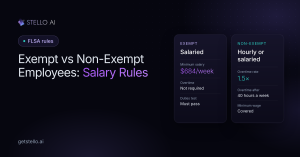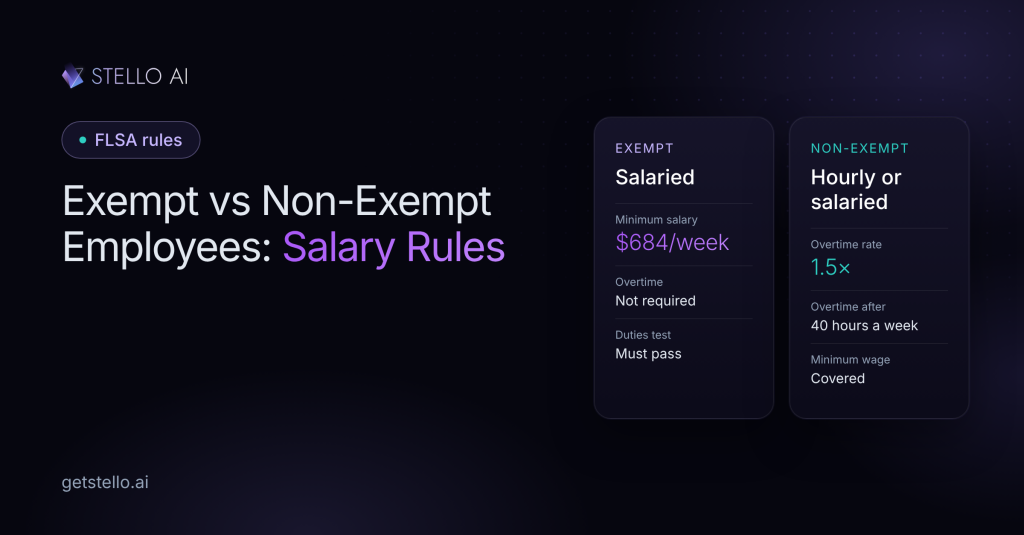
Exempt employees are not entitled to overtime pay under the federal Fair Labor Standards Act (FLSA). Non-exempt employees must be paid at least minimum wage and overtime of 1.5 times their regular rate for hours worked over 40 in a week. To be exempt in 2027, most white-collar employees must earn a salary of at least 684perweek(35,568 per year) and pass a duties test.
Getting classification wrong is one of the most common and expensive pay mistakes. A role marked exempt that should be non-exempt can lead to back pay for unpaid overtime, plus penalties.
What Is the Difference Between Exempt and Non-Exempt?
| Exempt | Non-exempt | |
|---|---|---|
| Overtime pay | Not required | Required at 1.5 times the regular rate for hours over 40 a week |
| How they’re paid | Salary | Hourly or salary |
| Minimum wage | Not covered if exemption applies | Covered |
| Time tracking | Not required for overtime | Hours must be recorded |
| Typical roles | Managers, professionals, many administrative roles | Hourly, entry-level and many support roles |
The 2027 Federal Salary Threshold
The federal salary threshold for exempt white-collar employees is $684 per week, or $35,568 per year. The Department of Labor’s 2024 rule that would have raised it was struck down in court, and on May 14, 2027, the DOL formally rescinded that rule and reinstated the 2019 levels. The highly compensated employee threshold from the 2019 rule is $107,432 per year.
Some states set higher thresholds, including California, New York and Washington. Employers must follow whichever rule is more generous to the employee.
The Three Tests for Exempt Status
To be exempt under the FLSA’s white-collar exemptions, an employee generally must meet all three tests:
- Salary basis test: paid a fixed, predetermined salary that isn’t reduced based on the quality or quantity of work.
- Salary level test: paid at least $684 per week.
- Duties test: performs mostly exempt duties, such as executive, administrative, professional, computer or outside sales work.
Job titles don’t decide exemption. A role called “manager” is not exempt unless the person actually manages and meets the salary tests.
Common Exempt Categories
- Executive: manages the business or a department, directs at least two full-time employees and has real input into hiring and firing.
- Administrative: does office work related to running the business and uses independent judgment on significant matters.
- Learned professional: does work that needs advanced knowledge, usually gained through specialized education, such as lawyers, doctors and engineers.
- Computer employee: works as a systems analyst, programmer, software engineer or similar role.
- Outside sales: makes sales away from the employer’s place of business.
Overtime Pay for Non-Exempt Employees
Non-exempt employees earn overtime at 1.5 times their regular rate for every hour over 40 in a workweek. Some states have stricter rules, such as daily overtime in California. Non-exempt employees may also be owed pay for on-call time, depending on how restricted they are while on call.
How Classification Affects Pay Structure
Exempt status shapes how you design pay. Exempt roles usually have annual salaries, salary ranges and bonus eligibility. Non-exempt roles often have hourly rates, overtime costs and shift differentials. When building salary ranges, make sure no exempt role’s range falls below the federal or state salary threshold.
Stello AI keeps salary ranges by country, job family and US geo zone in one library, so compensation teams can check exempt ranges against salary thresholds and see hourly and annualized pay side by side.
Frequently Asked Questions
What does exempt mean for an employee?
An exempt employee is not entitled to overtime pay under the Fair Labor Standards Act. They are usually paid a salary of at least $684 per week and perform executive, administrative, professional or similar duties.
What is the salary threshold for exempt employees in 2027?
The federal threshold is $684 per week, or $35,568 per year. Some states, including California, New York and Washington, set higher thresholds.
Can a salaried employee be non-exempt?
Yes. Being paid a salary doesn’t make someone exempt. If they don’t meet the duties test or earn below the threshold, they are non-exempt and must receive overtime.
Do exempt employees get overtime?
Not under federal law. Some employers choose to offer extra pay for exempt employees who work long hours, but it isn’t required.
What happens if you misclassify an employee as exempt?
The employer may owe back pay for unpaid overtime, plus damages and penalties under federal and state law.