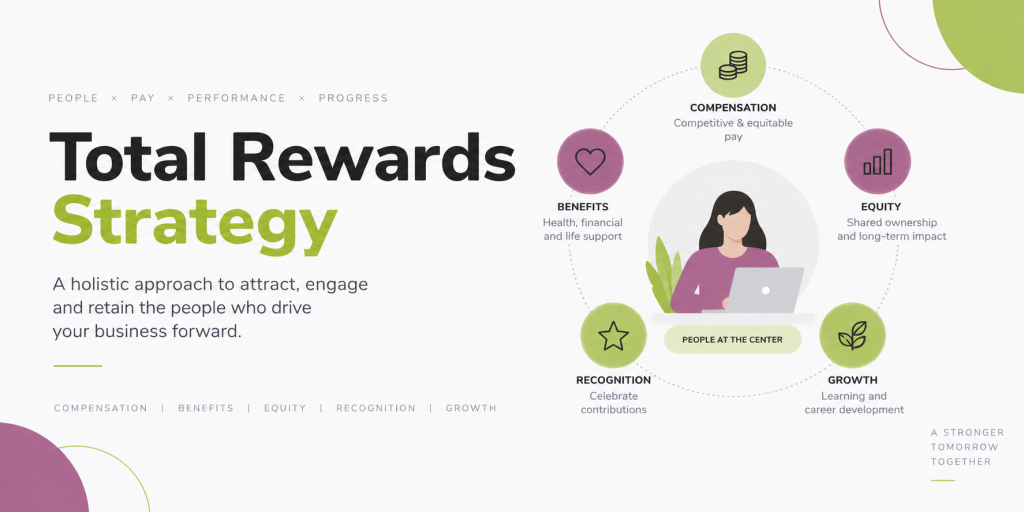
Ask an employee what they’re paid, and most will tell you their base salary. Ask what they actually receive from the company, and the real number is usually much bigger, base pay plus bonus, equity, benefits, retirement contributions, and often things employees don’t think to count at all, like professional development budgets or wellness stipends.
A total rewards strategy is how a company connects all of those pieces into one coherent story instead of a scattered list of separate programs. This guide covers what total rewards strategy actually means, the core components it needs to bring together, and how to build one that actually influences hiring and retention rather than just sitting in a slide deck.
TL;DR
- A total rewards strategy coordinates compensation, equity, benefits, well-being, and development into one connected system, instead of separate, siloed programs.
- Benefits often add 20-30% on top of base salary, but get little attention compared to cash pay when communicating value to employees.
- Building a strategy takes 7 steps: define your philosophy, inventory what you offer, benchmark the full package, find gaps, build total rewards statements, communicate consistently, and review regularly.
- A total rewards statement, a personalized breakdown of salary, bonus, equity, and benefits, is often the single artifact that makes the strategy actually land with employees.
- The most common mistake: treating total rewards as better packaging rather than fixing an underlying package that isn’t actually competitive.
What is a total rewards strategy?
A total rewards strategy is a company’s coordinated approach to everything it offers employees in exchange for their work, spanning compensation, benefits, equity, and the broader employee experience, designed and communicated as a single, connected system rather than a set of disconnected programs run by different teams.
The “total” in total rewards matters. Most companies already have a comp strategy, a benefits package, and maybe an equity program. What’s often missing is the strategy layer that ties them together intentionally, so the pieces reinforce each other instead of being designed and budgeted in isolation, and so employees actually understand the full value of what they’re receiving.
The core components of total rewards
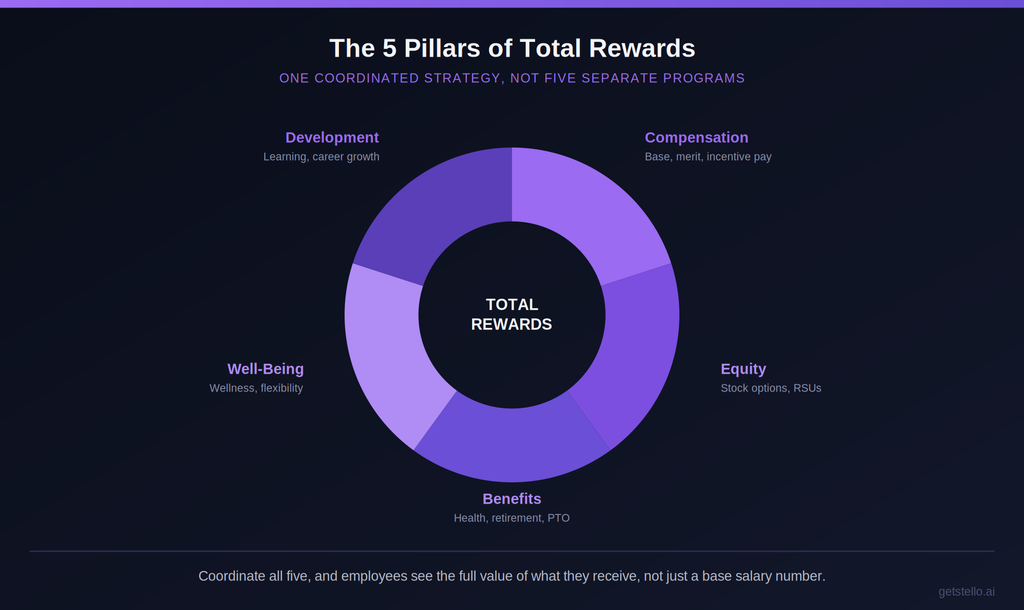
Most total rewards frameworks organize around five broad categories.
Compensation
The most visible piece: base salary, merit increases, and incentive compensation like bonuses or commission. This is typically where comp benchmarking, salary bands, and compa-ratio all live, the mechanics of ensuring base and variable pay stay competitive and internally consistent.
Equity
For companies that offer it, equity compensation, stock options, RSUs, or other ownership stakes, represents a significant and often underappreciated part of total compensation, particularly at startups and growth-stage companies where cash budgets are more constrained.
Benefits
Health insurance, retirement contributions, paid time off, parental leave, and other structured benefits. These often represent a substantial percentage of total compensation cost to the company, frequently 20% to 30% on top of base salary, but get comparatively little attention in how they’re communicated to employees.
Well-being and work-life programs
A newer and fast-growing category: mental health support, wellness stipends, flexible or remote work policies, childcare support, and similar programs designed to support employees beyond strict financial compensation.
Development and career growth
Learning budgets, tuition reimbursement, internal mobility programs, and clear career progression frameworks. Increasingly important for retention, particularly for employees who value growth opportunities as much as or more than incremental pay increases.
Also read: What is Incentive Compensation? A Guide for Comp and HR Teams
Why total rewards strategy matters
A coordinated total rewards strategy solves a few problems that siloed program management doesn’t.
It clarifies the real value of the offer. Employees, and candidates evaluating an offer, often dramatically underestimate what they’re actually receiving when they only see a base salary number. A well-communicated total rewards package makes the full picture visible.
It prevents redundant or conflicting spend. Without coordination, it’s easy for a benefits team, a comp team, and a wellness initiative to each budget independently for overlapping goals, wellness stipends and health benefits, for instance, without anyone stepping back to see the full financial picture or whether the combination actually serves employees well.
It strengthens the employer brand. Companies with a clearly articulated total rewards strategy have a much stronger story to tell candidates than a company that can only describe its salary range in isolation.
It supports retention more holistically. Compensation alone is a blunt retention tool. A well-rounded total rewards strategy gives a company more levers, career growth, flexibility, well-being support, to address the different reasons different employees might otherwise leave.
Also read: Average Raise Percentage: What to Expect in 2026
How to build a total rewards strategy
1. Define your total rewards philosophy
Before assembling programs, decide what your company is actually trying to achieve with total rewards. This usually means answering a few strategic questions: how competitive do you want to be on cash versus equity versus benefits, which market percentile are you targeting, and what does the company want employees to feel about their compensation, not just receive.
2. Inventory everything you currently offer
Many companies are surprised, once they actually list everything out, by how much they already offer that never gets communicated clearly. Pull together compensation structure, equity program, full benefits package, and every ancillary program, wellness, learning budgets, perks, into one consolidated view.
3. Benchmark against the market
Use compensation and benefits benchmarking data to understand how your total package compares to companies you compete with for talent, not just on base salary, but across the full picture: equity, benefits generosity, and well-being programs.
4. Identify gaps and redundancies
With the full inventory in hand, look for both obvious gaps, an underdeveloped benefit competitors offer, and redundancies, overlapping programs that could be consolidated into a more effective single offering.
5. Build total compensation statements
A total rewards statement translates all of this into something employees can actually see and understand: a personalized breakdown showing base salary, bonus or incentive pay, equity value, benefits cost, and other program value, all in one place. This is one of the highest-leverage, lowest-cost tools for making a total rewards strategy actually land with employees rather than staying an internal HR concept.
6. Communicate consistently, not just once a year
Total rewards value is easy to forget if it’s only mentioned during annual open enrollment or a comp review. Building regular touchpoints, at hiring, during onboarding, at review cycles, and through periodic total rewards statements, keeps the full picture visible year-round.
7. Review and evolve the strategy regularly
Market conditions, employee expectations, and company priorities all shift. A total rewards strategy built for a 50-person startup needs real revisiting by the time that company has scaled to 500 employees with a much more complex benefits and equity picture.
Total rewards statements: making the strategy visible
Of all the tools in a total rewards strategy, the total rewards statement deserves special attention, since it’s often the single artifact that determines whether the strategy actually reaches employees or stays buried in HR planning documents.
A good total rewards statement typically shows, in one place: current base salary, recent or projected incentive pay, current equity value and vesting status, the employer’s cost for health and retirement benefits, and estimated value of any additional programs like wellness stipends or learning budgets.
Done well, this consistently produces one of the more common reactions HR teams hear: employees genuinely didn’t realize how much their total compensation actually added up to. That gap between perceived and actual value is exactly what a coordinated total rewards strategy, made visible through a clear statement, is designed to close.
Common total rewards strategy mistakes
Treating total rewards as a communications exercise only. A total rewards statement that dresses up an uncompetitive underlying package doesn’t fix the real problem. The strategy has to start with genuinely competitive, well-designed programs, not just better packaging of mediocre ones.
Letting different teams plan in isolation. If comp, benefits, and wellness budgets are set independently without any shared strategy or visibility into each other’s plans, the result is rarely the most effective use of the combined spend.
Ignoring what employees actually value. A total rewards package built entirely around what leadership assumes employees want, without ever asking, often misses the mark. Employee listening, through surveys or direct feedback, should inform what the strategy actually prioritizes.
Underinvesting in communication. Even an excellent total rewards package fails to do its job if employees don’t understand or remember what they’re receiving. This is a recurring, ongoing communication effort, not a one-time announcement.
Applying one strategy uniformly across very different employee needs. A total rewards approach that works well for early-career employees may land very differently for senior employees closer to retirement, or for employees in different countries with different benefit norms and expectations. Flexibility within the overall strategy matters.
FAQs
What is the difference between total compensation and total rewards?
Total compensation typically refers to the financial elements, base salary, bonus, equity, and sometimes the cash value of benefits. Total rewards is the broader concept, encompassing total compensation plus non-financial elements like well-being programs, career development, and workplace flexibility.
Who owns total rewards strategy at a company?
It’s usually led by HR or a dedicated total rewards or compensation and benefits team, but it requires close coordination with finance, since it touches the full compensation and benefits budget, and often with company leadership, since it reflects broader talent strategy decisions.
How often should a total rewards statement be provided to employees?
Many companies provide a formal total rewards statement annually, often timed with the comp review cycle, though some provide updated statements more frequently, particularly for equity-heavy roles where vesting status and valuation change more often.
Does total rewards strategy apply to small companies, or only large ones?
It applies at any size, though the formality scales with company size. Even a small company benefits from clearly articulating and communicating its full compensation and benefits picture, even if the underlying programs are simpler than what a large enterprise offers.
How does total rewards strategy relate to compensation benchmarking?
Compensation benchmarking typically focuses on base and incentive pay specifically. Total rewards strategy uses benchmarking more broadly, comparing the full package, benefits generosity, equity competitiveness, and well-being programs, against the market, not just cash compensation alone.
The bottom line
A total rewards strategy turns a scattered set of comp, benefits, and wellness programs into one coordinated story, and makes sure employees actually understand the full value of what they’re receiving rather than fixating on a single base salary number. Building one well means starting with a clear philosophy, inventorying what you already offer, benchmarking the full picture against the market, and investing real effort into communicating it consistently, not just once a year during open enrollment.