For most of American work history, talking about money at work was taboo. You didn’t ask a coworker what they made, you didn’t put a number in a job ad, and if you got lowballed on an offer, you had almost no way of knowing it. That culture is unraveling fast. Over the past five years, pay transparency has gone from a niche progressive policy idea to a legal requirement covering a majority of the US workforce.
This guide explains what pay transparency actually means, why it exists, what the law requires (and where), and what it means in practice for both job seekers and employers.
TL;DR
- Pay transparency requires employers to share salary or wage information with job candidates, current employees, or both.
- There’s no federal law — pay transparency is regulated at the state and local level, and the federal contractor rule was rescinded in January 2025.
- ~17–18 states plus D.C. have statewide pay transparency laws as of 2026, with more pending.
- Two main types: proactive disclosure (range posted in the job ad) vs. reactive disclosure (range shared only on request).
- Strictest states — Colorado, California, Washington, New York, Illinois — require disclosure for both external postings and internal promotions.
- Related but different: salary history bans stop employers from asking what you currently or previously earned.
- Remote hiring matters — companies often must comply with the law of whichever state the remote employee lives in.
- Transparency ≠ equity — posting a range doesn’t guarantee fair pay within that range; equity audits are a separate step.
- For employers, real pay bands and internal equity are now compliance essentials, not nice-to-haves.
Pay Transparency, Defined
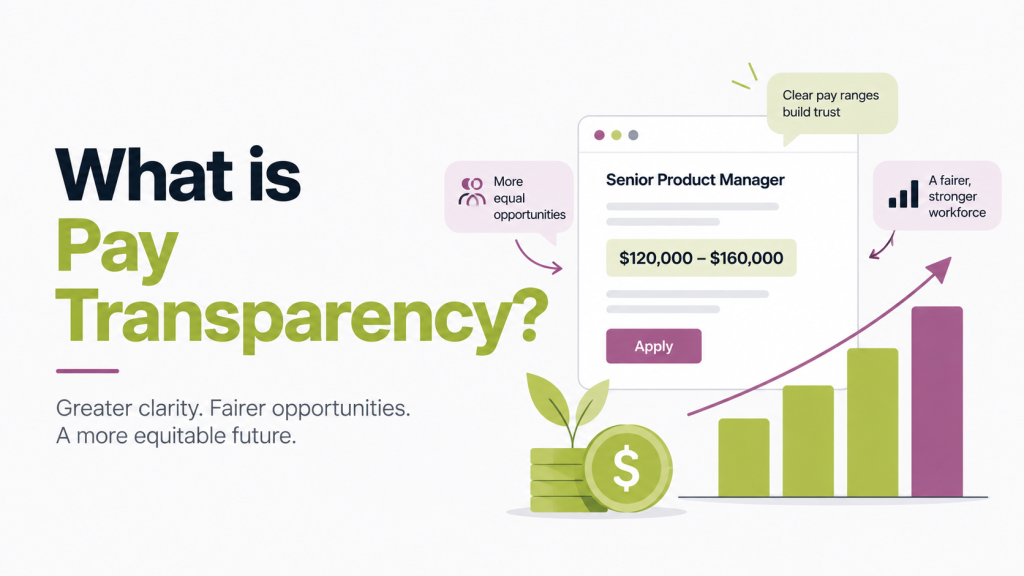
Pay transparency is the practice — and increasingly the legal requirement — of openly sharing compensation information with job candidates, current employees, or both. That can mean:
- Posting a salary or wage range in a job listing
- Disclosing pay ranges to employees who are up for a promotion or transfer
- Sharing compensation on request, even if it isn’t posted publicly
- Protecting employees’ right to discuss pay with coworkers without fear of retaliation
- Publishing pay equity or pay gap data, in some cases, at the company or even government level
Transparency exists on a spectrum. On one end is full openness — some companies publish every employee’s salary internally, or even publicly (Buffer and Whole Foods are often-cited examples). On the other end is the legal minimum: posting a wage range in a job ad because a state law requires it. Most US companies today sit somewhere in the middle, driven less by philosophy and more by compliance.
Why Pay Transparency Became a Legal Issue
Pay transparency didn’t emerge from nowhere. It’s a direct response to three long-running problems in the US labor market:
1. The gender and racial pay gap. Women in the US earn roughly 83–85 cents for every dollar men earn, and the gap is wider for many women of color. Secrecy around pay has historically made it easy for these gaps to persist and hard for anyone to prove or challenge them.
2. Salary history as a bias-multiplier. For decades, employers routinely asked candidates what they currently earned and anchored new offers to that number. If someone was underpaid at their last job — often due to bias, not performance — that underpayment followed them from job to job. Salary history bans (a close cousin of pay transparency laws) were the first legislative response to this.
3. Information asymmetry in negotiation. Employers know their budget range for a role. Candidates historically didn’t. That imbalance consistently favored employers, particularly with candidates who negotiate less — a pattern documented across gender and racial lines.
Pay transparency laws are, at their core, an attempt to correct all three problems by removing the information advantage employers have traditionally held.
Also read: Average Raise Percentage: What to Expect in 2026
What the Law Actually Requires
There is currently no federal pay transparency law in the United States. A federal contractor pay transparency requirement existed under a prior executive order but was rescinded via Executive Order 14173 in January 2025. What exists instead is a fast-growing patchwork of state and local laws — and the patchwork is the whole story here, because compliance obligations vary sharply depending on where an employer and its employees are located.
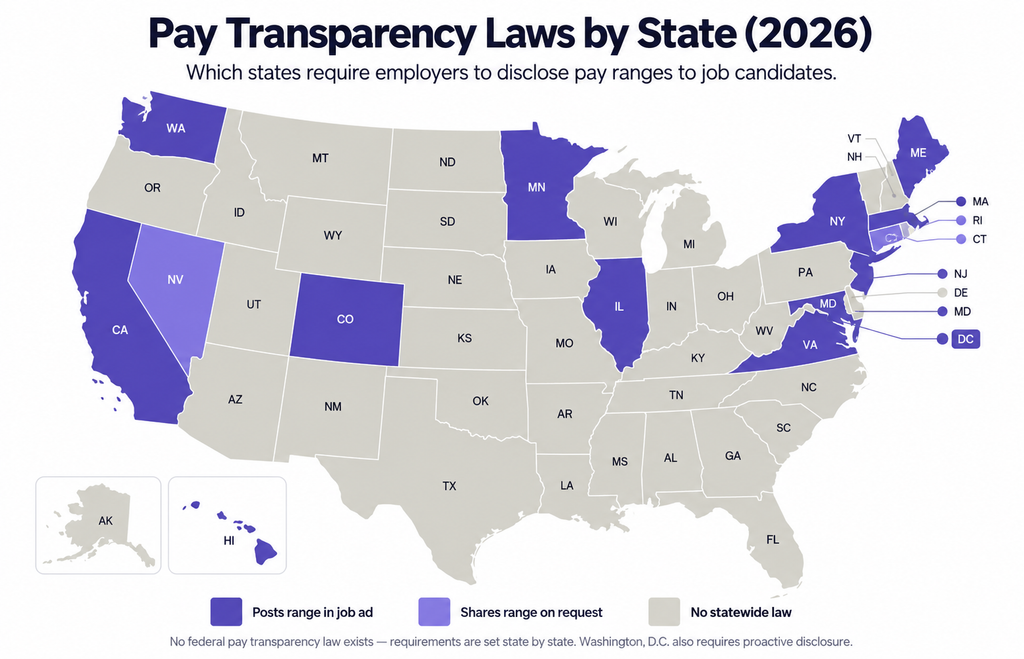
As of 2026, roughly 17–18 states plus Washington, D.C. have active statewide pay transparency laws, with several more states actively considering bills. Broadly, these laws fall into three categories:
Proactive disclosure laws require employers to include a pay range directly in the job posting, before anyone applies. States in this group include Colorado, California, Washington, New York, Illinois, New Jersey, Minnesota, Massachusetts, Hawaii, Maryland, Ohio (in Cincinnati and Toledo), and, as of 2026, Virginia and Maine. Colorado, Illinois, New York, California, and Washington are generally considered the strictest, requiring disclosure for both external job postings and internal promotion/transfer opportunities.
Reactive (on-request) disclosure laws only require an employer to share a pay range if a candidate or employee asks for it. Connecticut, Rhode Island, and Nevada fall into this category today, though Connecticut is set to shift to proactive disclosure in October 2026 — a pattern seen repeatedly, where states start with a lighter reactive requirement and later tighten it into a proactive one.
Salary history bans, which are related but distinct, prohibit employers from asking candidates about their current or past pay, or from relying on prior salary to set a new offer. These exist in more states than proactive disclosure laws do, because they were the earlier, lighter-touch policy response.
A few structural details matter a lot for compliance and are easy to miss:
- Employee-count thresholds vary widely. New York State’s law applies to employers with as few as 4 employees. Other states set the bar at 15, 25, or 50+.
- Remote work multiplies obligations. If a company posts a remote role that could be filled by someone living in Colorado, it generally has to comply with Colorado’s law — regardless of where the company itself is headquartered. Multi-state hiring means multi-state compliance.
- “Good faith range” requirements are tightening. Several states, including Colorado in 2026, have clarified that posted ranges must reflect what the company would actually pay, not an artificially wide placeholder range (e.g., “$40,000–$250,000”) designed to technically comply while disclosing nothing useful.
Also read: How Does Equity Compensation Work in a Private Company?
Pay Transparency vs. Pay Equity — Not the Same Thing
It’s a common mix-up, so it’s worth separating clearly:
- Pay transparency is about disclosure — making pay information visible and accessible.
- Pay equity is about fairness — ensuring people doing comparable work are paid comparably, regardless of gender, race, or other protected characteristics.
Transparency is a tool that can help surface and correct equity problems, but posting a range doesn’t automatically make pay fair. A company can be fully “transparent” about a pay range and still have systemic equity issues within that range — for instance, consistently placing certain groups at the bottom of a posted band. Because of this, pay transparency is increasingly discussed alongside pay equity audits, where companies analyze existing compensation data for statistically significant gaps tied to gender, race, age, or other factors, independent of what’s posted publicly.
What Pay Transparency Means for Employees
If you’re job hunting or currently employed, transparency laws change the practical landscape in a few concrete ways:
- You can see the range before you apply or interview, in states with proactive disclosure laws — no more guessing whether a role pays $60K or $120K.
- You generally can’t be penalized for discussing your pay with coworkers. This protection actually predates most state transparency laws — it comes from the National Labor Relations Act, which protects “concerted activity” around wages for most private-sector employees, regardless of state.
- You’re less likely to be asked for your salary history, in states with salary history bans, which removes a common anchor point that historically depressed offers for underpaid workers.
- Posted ranges are not guarantees. A range tells you the band an employer is working within, not what you personally will be offered — that still depends on experience, negotiation, location, and internal equity considerations.
Also read: Pay Equity Analysis: How to Conduct One (Step-by-Step)
What Pay Transparency Means for Employers
For HR, People teams, and compensation leaders, transparency laws have shifted pay strategy from a private, ad hoc practice into something that has to be structured, documented, and defensible:
- Job architecture and pay bands become mandatory, not optional. You can’t post a defensible range for a role if you haven’t already defined what that role is worth relative to others in your organization.
- Ranges need to be real, not padded. Regulators in stricter states are increasingly scrutinizing artificially wide ranges as a form of non-compliance.
- Multi-state hiring means tracking multiple, sometimes conflicting, requirements — a company hiring remotely across 10 states may need 10 different compliance approaches for the same role.
- Internal equity exposure increases. Once a range is public, current employees can see it too — and compare it to what they’re actually paid. Companies that haven’t audited internal pay equity before going transparent often discover gaps they now have to explain or fix.
- Compensation communication becomes a retention issue, not just a compliance one. Employees increasingly expect to understand how pay decisions are made — what the band is, how someone moves within it, and why.
The Direction of Travel
The trend line here is unambiguous: more states, more proactive disclosure, larger scope. States that started with reactive, on-request laws (Connecticut, and previously others) have moved to proactive posting requirements within a few years. Employee-count thresholds have tended to fall over time, not rise, pulling smaller employers into scope. And enforcement scrutiny of “fake compliance” — like placeholder ranges — has increased rather than relaxed.
For companies without an established pay structure, the practical implication is that pay transparency isn’t a policy to watch from the sidelines. Given how quickly a company’s hiring footprint can trigger obligations in a new state, building real pay bands, conducting periodic equity reviews, and establishing a consistent range-setting methodology has become a baseline operational requirement — not a future consideration.
This article is intended as a general informational overview and does not constitute legal advice. Pay transparency requirements vary by state and change frequently; employers should consult employment counsel to confirm compliance obligations for their specific workforce and locations.