If you’ve spent any time shopping for HR software, you’ve probably seen the terms HCM and HRIS used almost interchangeably. Vendors slap both labels on similar-looking product pages, and it’s easy to walk away thinking they mean the same thing.
They don’t.
The difference matters more than it seems, especially if you’re trying to figure out what your team actually needs versus what a sales deck is trying to sell you. Get the distinction wrong and you either end up overpaying for capabilities you won’t use, or underbuying a system that can’t scale with your workforce.
Here’s the difference, broken down without the jargon.
TL;DR
- HRIS is the operational core: employee records, payroll, benefits, and compliance.
- HCM includes everything an HRIS does, plus talent, performance, learning, compensation, and workforce analytics.
- HRIS is administrative. HCM is strategic. Neither is “better,” it depends on where your company is.
- Compensation planning (pay bands, merit cycles, pay equity) sits on the HCM side, not basic payroll.
- Vendor labels are unreliable. Check the actual feature list before you decide what you’re buying.
What is an HRIS?
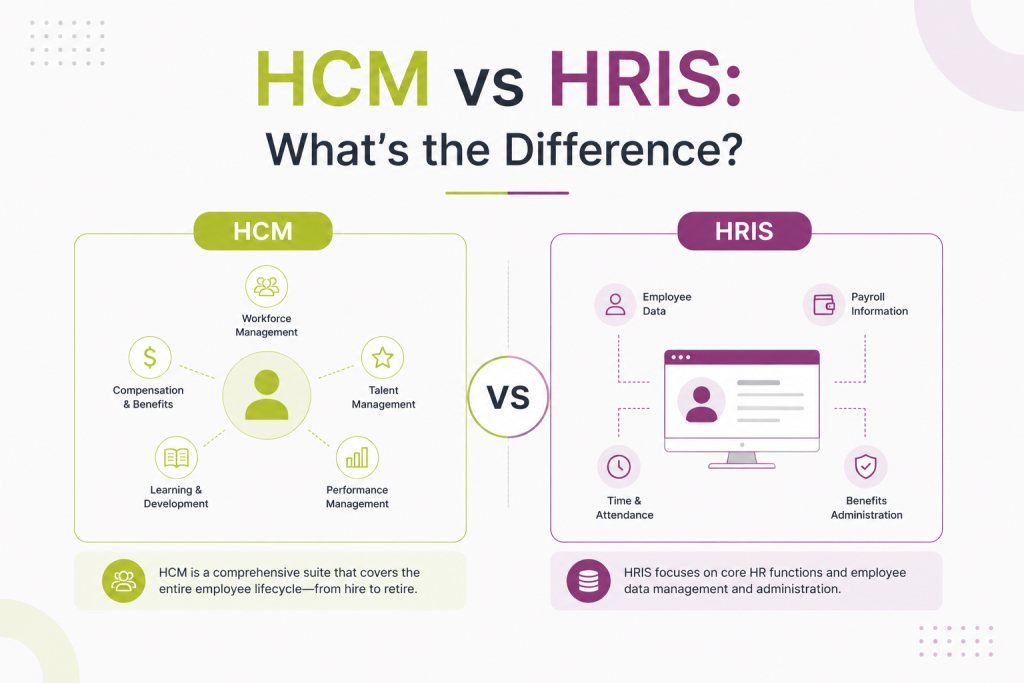
HRIS stands for Human Resource Information System. Think of it as the operational core of HR: a centralized system for storing and managing employee data.
An HRIS typically handles:
- Employee records (personal details, job history, documents)
- Payroll processing
- Benefits administration
- Time and attendance tracking
- Basic compliance reporting
The job of an HRIS is to be the single source of truth for “who works here, what’s their role, and what do we owe them.” It’s transactional and administrative by nature. If you picture HR as running a business, the HRIS is the filing cabinet, the payroll clerk, and the compliance officer rolled into one system.
Most companies, even small ones, run on some form of HRIS. It’s the foundation everything else gets built on.
Also read: What is a Merit Increase? A Complete Guide
What Is an HCM?
HCM stands for Human Capital Management, and it’s a broader category. An HCM platform includes everything an HRIS does, but adds strategic, people-first capabilities on top.
A full HCM suite typically covers:
- Everything in an HRIS (records, payroll, benefits)
- Talent acquisition and recruiting
- Onboarding
- Performance management
- Learning and development
- Succession planning
- Compensation management
- Workforce analytics and planning
The mindset shift is the key difference. An HRIS asks, “Is the data accurate and is payroll running?” An HCM asks, “How do we attract, develop, retain, and pay people in a way that drives the business forward?”
If HRIS is administrative, HCM is strategic. It treats your workforce as a source of competitive advantage, not just a line item to manage.
HCM vs HRIS: The Core Differences at a Glance
| HRIS | HCM | |
|---|---|---|
| Primary focus | Data management and administration | Strategic workforce management |
| Scope | Payroll, benefits, records, compliance | Everything in HRIS, plus talent, performance, compensation, planning |
| Mindset | Operational | Strategic |
| Best suited for | Smaller teams with straightforward HR needs | Growing or complex organizations that need to manage the full employee lifecycle |
| Typical buyer | HR generalist or ops lead | HR/People leader, CHRO, or Total Rewards team |
Where the Confusion Comes From
Part of the reason these terms get muddled is that vendors don’t use them consistently. Some legacy “HRIS” platforms have bolted on talent and performance modules over the years and now market themselves as HCM suites, even though the underlying architecture is still record-keeping first.
At the same time, some modern HCM platforms started as point solutions (say, a recruiting tool or a performance tool) and expanded into a broader suite, sometimes without a truly unified data model underneath.
So when you’re evaluating vendors, the label on the pricing page tells you less than the actual feature list. Ask directly: does this system handle compensation planning? Succession planning? Workforce analytics? If the answer is no across the board, you’re likely looking at an HRIS regardless of what the marketing calls it.
Also read: HRIS Implementation: A Step-by-Step Guide
Where Compensation Fits In
Compensation is a good example of where the HRIS/HCM line gets drawn in practice.
Basic payroll, the “make sure people get paid on time and correctly” function, lives comfortably inside an HRIS. But compensation planning is a different animal. It involves:
- Building and managing pay structures and salary bands
- Running annual merit and bonus cycles
- Modeling pay equity across the organization
- Benchmarking against market data
- Giving managers guided, defensible recommendations
This is strategic work, not administrative work, which is exactly why it sits on the HCM side of the line. Most legacy HRIS platforms either don’t handle it at all or offer a bare-bones spreadsheet replacement bolted onto the payroll module.
This is also why purpose-built compensation management platforms exist as a category of their own. Rather than treating compensation as an afterthought inside a broader HCM suite, tools like Stello focus specifically on making pay planning, pay equity analysis, and merit cycles fast and defensible, without forcing HR teams to wait on a slow, generalist system to catch up.
Which One Does Your Company Actually Need?
It depends on where you are.
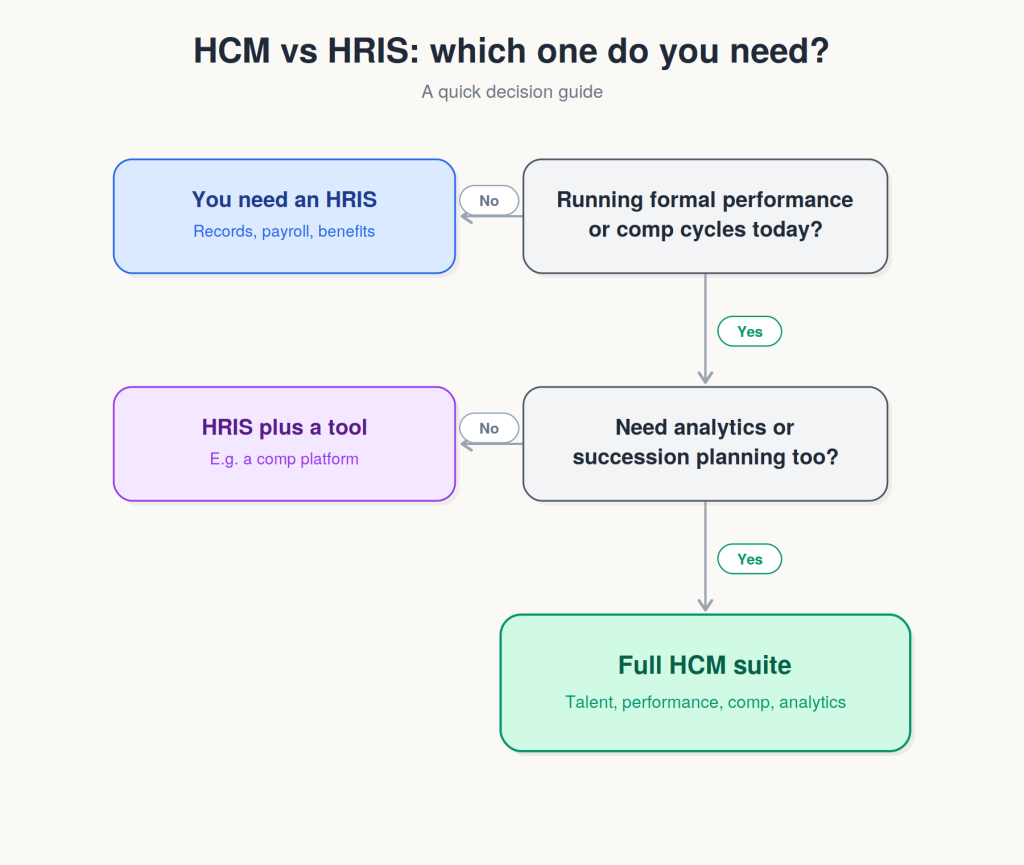
You probably just need an HRIS if:
- You’re a small team with straightforward payroll and benefits needs
- You’re not yet running formal performance or compensation cycles
- Your priority is getting the basics right and staying compliant
You probably need HCM capabilities if:
- You’re scaling and need to manage the full employee lifecycle
- You’re running structured performance reviews, merit cycles, or succession planning
- You need workforce data to inform business decisions, not just payroll runs
- Pay equity and compensation strategy are becoming board-level or leadership-level concerns
Many growing companies end up in a hybrid setup: an HRIS as the system of record for core employee data, paired with specialized tools, like a dedicated compensation platform, for the strategic pieces that a generalist HCM suite handles poorly.
Also read: What is Total Rewards? A Guide for HR and People Teams
The Bottom Line
HRIS and HCM aren’t competing terms for the same thing. HRIS is the operational foundation: employee records, payroll, benefits, compliance. HCM builds on that foundation with strategic capabilities: talent, performance, and compensation management.
Neither is inherently better. The right choice depends on your company’s size, complexity, and where you are in building out your people strategy. What matters is understanding what each system actually does, so you’re buying based on capability, not category labels.
Compensation planning is one of the areas where generalist HR systems tend to fall short. If pay equity, merit cycles, or salary benchmarking are becoming a headache inside your current HRIS or HCM, Stello is built specifically to solve that.
FAQs-
Is Workday an HCM or an HRIS?
Workday markets itself as a full HCM suite. It covers core HR records and payroll as well as talent, performance, and workforce planning, which puts it on the HCM side of the line rather than a basic HRIS.
Can a company run on just an HRIS without HCM features?
Yes. Plenty of small and mid-sized companies run entirely on an HRIS, especially if they don’t yet have formal performance cycles, succession planning, or dedicated compensation strategy in place. As those needs grow, they typically add HCM capabilities on top.
Does an HRIS include compensation management?
Most HRIS platforms handle payroll, but not strategic compensation management. Pay structures, merit cycles, pay equity analysis, and benchmarking usually require either a full HCM suite or a dedicated compensation platform.
Is HCM more expensive than HRIS?
Generally, yes. HCM suites cover more ground, from talent acquisition to performance to compensation, so they tend to cost more than a standalone HRIS. The right comparison isn’t price alone, though, it’s whether you actually need the extra modules.
Can you use an HRIS and a specialized HCM tool together?
Yes, and many growing companies do exactly this. It’s common to keep an HRIS as the system of record for core employee data while layering on specialized tools, like a dedicated compensation platform, for the strategic work a generalist system doesn’t handle well.