Every HR team hits the same wall eventually. Requests pile up. Simple questions like “how many PTO days do I have left” or “can you update my address” take up hours that should go toward real people work. That is the problem a self-service HRIS is built to solve.
A self-service HRIS gives employees direct access to their own data and routine tasks, without needing to email HR or wait for a reply. It sounds simple. The impact is not.
TL;DR
Self-Service HRIS: Why Employee Self-Service Matters
- ● A self-service HRIS lets employees handle routine tasks themselves: updating personal info, checking PTO, downloading pay stubs, enrolling in benefits.
- ● Without it, HR turns into a ticket queue: manual requests, slower onboarding, data entry errors, and frustrated employees.
- ● Remote work, leaner HR teams, rising employee expectations, and compliance pressure have made self-service a baseline, not a bonus.
- ● Good self-service HRIS is self-explanatory, connects to payroll and other systems, works on mobile, and keeps sensitive changes behind proper approval.
- ● It is also an employee experience win: fewer small frictions, more trust, more ownership over one’s own data.
- ● To roll it out well: start with your most common HR requests, include managers, plan change management, and measure ticket volume and satisfaction before and after.
What a Self-Service HRIS Actually Does
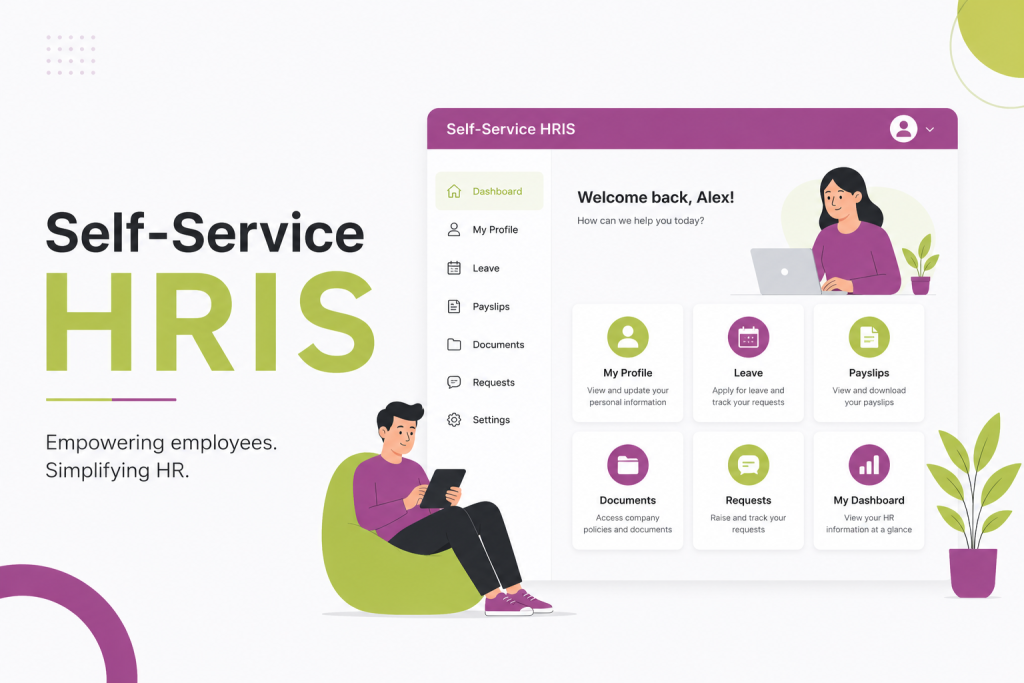
A self-service HRIS is the employee-facing layer of your HR information system. Instead of HR being the only door into payroll, benefits, time off, and personal records, employees get their own login and their own controls.
Typical capabilities include:
- Viewing and updating personal information (address, emergency contacts, banking details)
- Checking PTO balances and submitting time-off requests
- Downloading pay stubs and tax documents
- Enrolling in or changing benefits during open enrollment
- Viewing org charts, company policies, and onboarding materials
- Managers approving requests, running basic reports, and viewing team data
None of this is new technology. What has changed is how central it has become to a good employee experience, and how much time it saves an HR team that is usually stretched thin.
The Real Cost of Not Having One
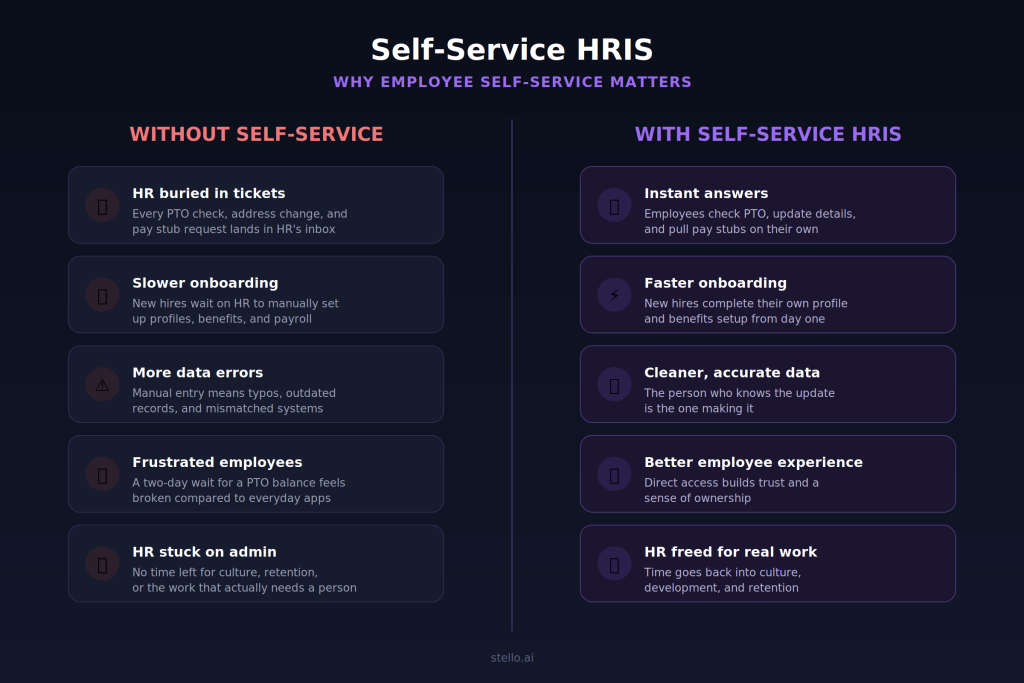
If you are still running HR through spreadsheets, shared inboxes, and manual approvals, you already know the cost. It just does not show up as a single line item. It shows up as:
HR becomes a ticket queue. Every address change, every PTO question, every “where is my pay stub” turns into a request that someone on your team has to manually process. Multiply that by a few hundred employees and HR stops doing strategic work entirely.
Slower onboarding. New hires wait on HR to manually set up their profiles, benefits, and payroll details instead of completing much of it themselves on day one.
More errors. Manual data entry means typos, outdated records, and inconsistent formats across systems. A self-service HRIS puts the update in the hands of the person who actually knows the correct information: the employee.
Frustrated employees. People expect the same convenience at work that they get everywhere else. If checking a PTO balance requires an email and a two-day wait, that gap is felt immediately, especially by younger employees used to instant access to their own information.
Also read: Pay Transparency Laws by State: What Changed for 2026
Why Self-Service HRIS Matters More Now
A few forces have made self-service HRIS less of a nice-to-have and more of a baseline expectation.
Remote and hybrid work. When employees are not walking past the HR office, self-service is often the only door they have into HR at all. It has to work well, because there is no hallway conversation to fall back on.
Leaner HR teams. Many companies are running HR with fewer people per employee than they used to. Self-service is one of the few ways to absorb growth without proportionally growing headcount in HR.
Rising expectations from employees. People manage their banking, health insurance, and taxes through self-service portals already. They expect the same at work. An HR experience that feels clunky by comparison reflects on the company, not just the tool.
Compliance pressure. Accurate, timely records matter more as pay transparency laws and reporting requirements expand. Self-service reduces the lag between a change happening in someone’s life and that change being reflected in the system.
Also read: HRIS vs HRMS: Which Do You Need?
What Good Self-Service HRIS Looks Like
Not every self-service HRIS is built the same way, and the difference shows up fast once people start using it.
It should be genuinely self-explanatory. If employees need a manual to update their own address, the tool has failed at its one job. Good self-service HRIS software uses plain language and a simple layout, not HR jargon.
It should reduce work for HR, not just move it around. Some tools technically let employees “self-serve” but still route every change through an approval queue that HR has to manually clear. That is not real self-service. It is the same bottleneck with an extra click.
It should connect to the rest of your systems. A PTO request submitted through self-service should update payroll and the manager’s calendar without anyone re-entering data. Disconnected tools create the same manual reconciliation work self-service is supposed to eliminate.
It should work on mobile. A large share of the workforce, especially in retail, healthcare, and field roles, does not sit at a desk. If self-service only works on a laptop, it is not really self-service for a big chunk of the company.
It should have the right guardrails. Employees should control their own basic information. Sensitive changes, like compensation or role, should still route through appropriate approval. Good self-service HRIS design draws that line clearly.
Also read: How to Create a Total Rewards Statement Employees Actually Read
The Employee Experience Angle
There is a tendency to talk about self-service HRIS purely as an efficiency play for HR. That is only half the story.
For employees, self-service is a trust signal. It tells people that the company respects their time enough to give them direct access to their own information, instead of making them ask permission for basic things. It also gives employees a sense of ownership. Checking your own PTO balance instead of waiting on an email reply feels like a small thing, but it adds up across hundreds of small interactions over a year.
Employee experience research consistently points to friction as one of the biggest drags on engagement. Not big, dramatic problems. Small, repeated frustrations that make work feel harder than it needs to be. A clunky HR process, where every basic task needs an email and a wait, is exactly that kind of friction.
Getting Started With Self-Service HRIS
If you are evaluating a move to self-service HRIS, a few things matter more than feature lists.
Start with what employees actually ask HR for most. Pull a few months of HR support tickets or emails. Whatever shows up most often (PTO questions, address updates, pay stub requests) is exactly what your self-service tool needs to nail first.
Map the manager layer too. Self-service is not just for individual employees. Managers approving time off, viewing team data, or handling basic reports save HR just as much time as employee-facing features do.
Plan for change management. Even a great tool fails if people do not know it exists or do not trust it. A short rollout, with a few examples of common tasks, goes a long way.
Measure it. Track ticket volume, time-to-resolution, and employee satisfaction before and after rollout. The value of a self-service HRIS should show up in numbers, not just in fewer complaints.
The Bottom Line
A self-service HRIS is not about replacing HR. It is about freeing HR from repetitive administrative work so the team can focus on the parts of the job that actually require a person: culture, retention, development, and the harder conversations that no portal can handle.
Employees get faster answers and more control over their own information. HR gets time back. Done well, self-service HRIS is one of the highest-leverage investments a growing company can make in how HR actually operates day to day.