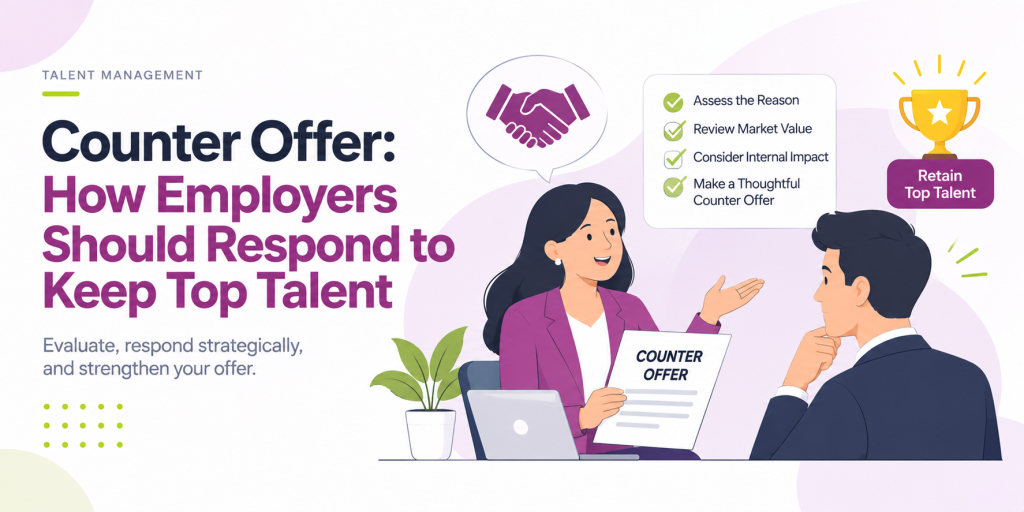
A counter offer is a new pay package an employer offers to an employee who has resigned or received an outside job offer, to persuade them to stay. It usually includes a raise and can also include a bonus, promotion or new responsibilities. A counter offer works best when pay was the main reason for leaving and the employee is critical to the business.
Counter offers can save a key person. They can also create pay inequity and teach other employees that the only way to get a raise is to find another job. The goal is to make fewer counter offers by fixing pay before people start looking.
What Is a Counter Offer?
In employment, a counter offer happens when an employee tells their manager they have another offer, and the company responds with a better package. The term is also used in hiring, when a candidate asks for more than the original job offer. This guide covers counter offers to current employees.
A counter offer can include:
- A base salary increase, often to match or beat the outside offer
- A one-time retention bonus for staying through a set date
![*]() A promotion or new title
- Equity or long-term incentives
- Non-pay changes, such as a new manager, remote work or a different project
Should You Make a Counter Offer?
Make a counter offer when the answer to most of these questions is yes:
- Is this person hard to replace? Gallup estimates the cost of replacing an employee at half to two times their annual salary.
- Is pay the main reason they are leaving? If they are leaving because of their manager or the work itself, more money rarely fixes it.
- Is their current pay below market? If so, the outside offer may simply reflect what the role is worth.
- Can you pay more without breaking your pay ranges? A counter that puts someone far above peers in the same role creates a new problem.
- Would you have given this raise anyway? If the answer is yes, the real issue is that your pay review came too late.
How Much Should a Counter Offer Be?
A counter offer should be based on what the role is worth in the market, not only on the size of the competing offer.
- Check the market rate for the role. Use current market data for the job, level and location.
- Compare the outside offer to the market. If the outside offer is at market and your pay is below it, a raise to market is fair.
- Check internal equity. Look at what peers in the same role and level earn. If you raise one person, others may also be below market.
- Decide on raise vs bonus. A base salary increase fixes a lasting gap. A retention bonus covers a short-term need, such as finishing a project.
Stello AI’s Market Pricing and Compensation Agent let HR teams check a role’s market rate, see where the employee sits in the salary range and compare peers in seconds, so a counter offer decision takes minutes instead of days.
The Risks of Counter Offers
Counter offers have real downsides for employers:
- Pay inequity: the employee who threatened to leave earns more than equally strong peers who stayed quiet.
- The wrong signal: others learn that an outside offer is the fastest way to a raise.
- Delayed exits: if pay was not the real reason, the employee may still leave later.
- Higher costs: repeated counter offers can push total pay costs above budget.
These risks are why many companies set a clear counter offer policy, with rules on who approves them and how far above the salary range they can go.
How to Reduce the Need for Counter Offers
The best counter offer is the one you never have to make. Most counter offers point to pay that fell behind the market before anyone noticed.
- Review pay against the market at least once a year, not only when someone resigns.
- Flag employees paid well below market and fix the gaps through targeted market adjustments.
- Watch for pay compression, where new hires earn close to or more than experienced staff.
- Share salary ranges so employees can see how their pay can grow.
- Run stay interviews with key employees to learn what would make them leave.
Gallup found that 52% of employees who left voluntarily said their manager or company could have done something to keep them.
Frequently Asked Questions
What is a counter offer in a job?
A counter offer is a better pay package an employer offers to an employee who has resigned or received an outside offer, to convince them to stay. It usually includes a raise and may include a bonus, promotion or new role.
Should an employer make a counter offer?
An employer should consider a counter offer when the employee is hard to replace, pay is the main reason for leaving, and a raise would keep their pay fair compared with peers.
How much should a counter offer be?
A counter offer should bring the employee’s pay in line with the market rate for their role, while keeping it fair compared with peers. Matching the outside offer is not always necessary if that offer is above market.
Is it better to give a raise or a bonus as a counter offer?
A raise is better when the employee’s base pay is below market, because the gap would return every year. A one-time retention bonus is better for keeping someone through a specific project or period.
How can companies avoid counter offers?
Companies can avoid most counter offers by reviewing pay against current market data every year, fixing below-market pay early, and making salary ranges and growth paths clear.