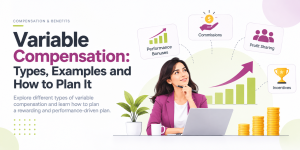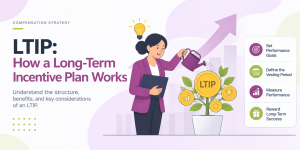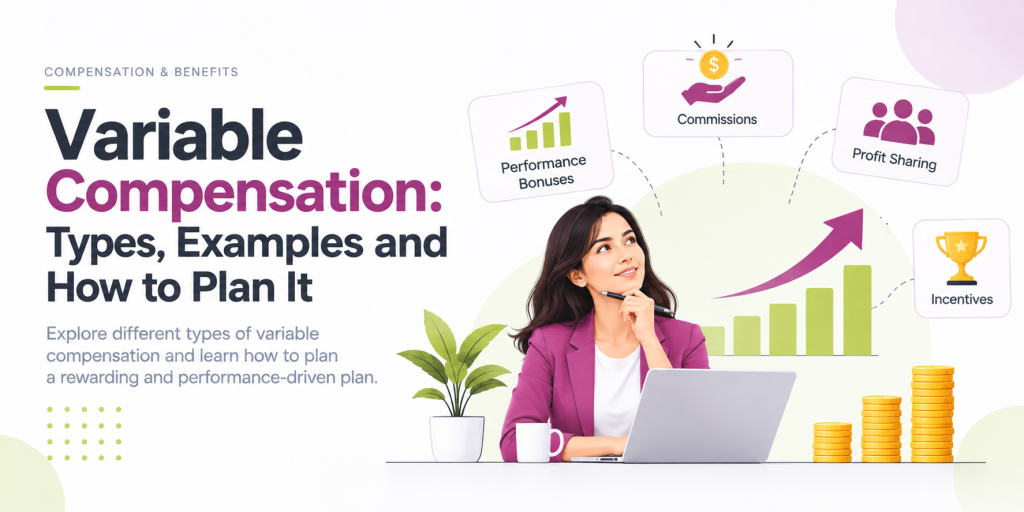
Variable compensation is pay that changes based on performance, results or other conditions, rather than staying the same every year like base salary. Common types include annual bonuses, sales commissions, profit sharing, spot awards and long-term incentives. In the 2026 Incentive Pay Practices Survey from WorldatWork and Compensation Advisory Partners, almost all for-profit companies said they use short-term incentives.
Variable pay lets companies reward results without locking in permanent costs. It also gives employees a clear link between what they achieve and what they earn.
What Is Variable Compensation?
Variable compensation, also called variable pay, is any part of an employee’s pay that is not guaranteed. The amount depends on how the employee, team or company performs.
Total cash pay is usually split into two parts:
- Fixed pay: base salary or hourly wages, paid regardless of results
- Variable pay: bonuses, commissions and incentives that rise and fall with performance
The share of variable pay usually grows with seniority. Executives often have a large part of their total pay at risk, while entry-level roles are mostly fixed.
Types of Variable Compensation
| Type | How it works | Typical use |
| Annual incentive plan (bonus) | Payout tied to company, team and individual goals for the year | Most salaried employees |
| Sales commission | A percentage of sales or revenue | Sales roles |
| Profit sharing | A share of company profit paid to employees | Broad-based plans |
| Spot award | A one-time reward for a specific achievement | Recognizing standout work |
| Retention bonus | A payment for staying through a set date | Key employees in risky periods |
| Long-term incentives | Stock or cash earned over several years | Executives and key talent |
The WorldatWork and CAP survey shows how widely these are used:
- Annual incentive plans: used by more than 80% of surveyed organizations, including 93% of public companies and 81% of private companies that use short-term incentives
- Spot awards: used by more than 40%
- Discretionary and retention bonuses: each used by about 30%
- Long-term incentives: used by 95% of public companies and 61% of private companies
What Is a Short-Term Incentive Plan?
A short-term incentive plan (STI) is a variable pay plan that rewards results over one year or less. The most common example is the annual bonus. A typical short-term incentive plan sets:
- A target bonus, often as a percentage of base salary
- Performance measures, such as revenue, profit or individual goals
- A payout curve that shows how much is paid at threshold, target and maximum performance
Short-term incentives work well. In the same survey, 86% of public companies and 72% of private companies rated their STI programs as effective or better.
Variable Compensation Examples
- Annual bonus: a product manager has a 15% target bonus. The company hits its goals and she meets hers, so she earns 15% of her base salary.
- Sales commission: an account executive earns 10% of the revenue from each deal they close.
- Spot award: an engineer receives $1,000 for fixing a critical outage over a weekend.
- Profit sharing: every employee receives a share of 5% of company profit, split by salary.
How to Plan Variable Compensation
- Decide what you want to reward. Company results, team goals, individual performance or a mix.
- Set target amounts by role and level. Use market data so total pay is competitive when targets are met.
- Pick clear measures. Employees should understand them and be able to influence them.
- Build the payout curve. Decide what happens below target, at target and above target.
- Model the cost. Estimate the total payout at threshold, target and maximum, and make sure it fits the budget.
- Communicate the plan. Employees should know how their variable pay is calculated before the year starts.
Stello AI’s Compensation Planning tool lets HR and finance teams model bonus pools, merit increases and market adjustments together, using market data for each role. That way, variable pay decisions are made with the full cost in view.
Variable Pay vs Merit Increases
A merit increase raises base salary permanently. Variable pay is earned again each year. Variable pay rewards results without adding fixed cost, and WTW reports that employers are moving away from broad-based increases toward more targeted, performance-driven pay. In WTW’s 2026 research, 34% of employers said they are increasing their use of retention bonuses or spot awards to keep key employees.
Read more about merit increases and how they differ from raises.
Frequently Asked Questions
What is variable compensation?
Variable compensation is pay that changes based on performance or results, such as bonuses, commissions, profit sharing and incentives. Unlike base salary, it is not guaranteed.
What is the difference between variable pay and fixed pay?
Fixed pay, such as base salary, stays the same regardless of results. Variable pay rises or falls depending on how the employee, team or company performs.
What are examples of variable pay?
Common examples include annual bonuses, sales commissions, profit sharing, spot awards, retention bonuses and long-term incentives like performance shares.
What is a short-term incentive plan?
A short-term incentive plan rewards results over one year or less. The annual bonus is the most common type, usually set as a percentage of base salary.
Is variable compensation taxable?
Yes. Bonuses, commissions and other variable pay are taxable wages. Employers often withhold federal tax on them at the 22% supplemental wage rate for amounts up to $1 million a year.