
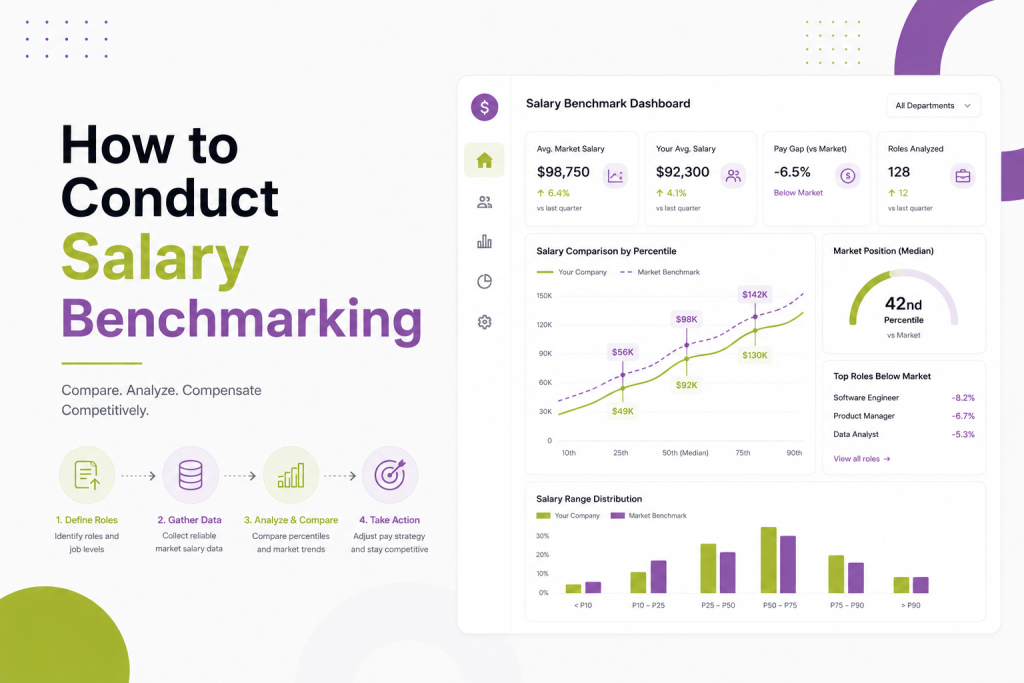
If you have ever set a salary based on a gut feeling, a competitor’s job posting, or “what we paid the last person in this role,” you are not alone. Most companies start this way. But as headcount grows, that approach starts to break. Pay gaps appear. Offers get rejected. Your best performers start taking calls from recruiters. And when someone finally asks “how did we land on this number,” there is no good answer.
Salary benchmarking fixes that. It replaces guesswork with data, and gut feeling with a repeatable process. This guide walks through exactly how to do it, step by step, whether you are building your first compensation structure or auditing one that has drifted out of sync with the market.
- → Salary benchmarking compares your pay to the external market. It is different from a pay equity audit, which compares pay internally.
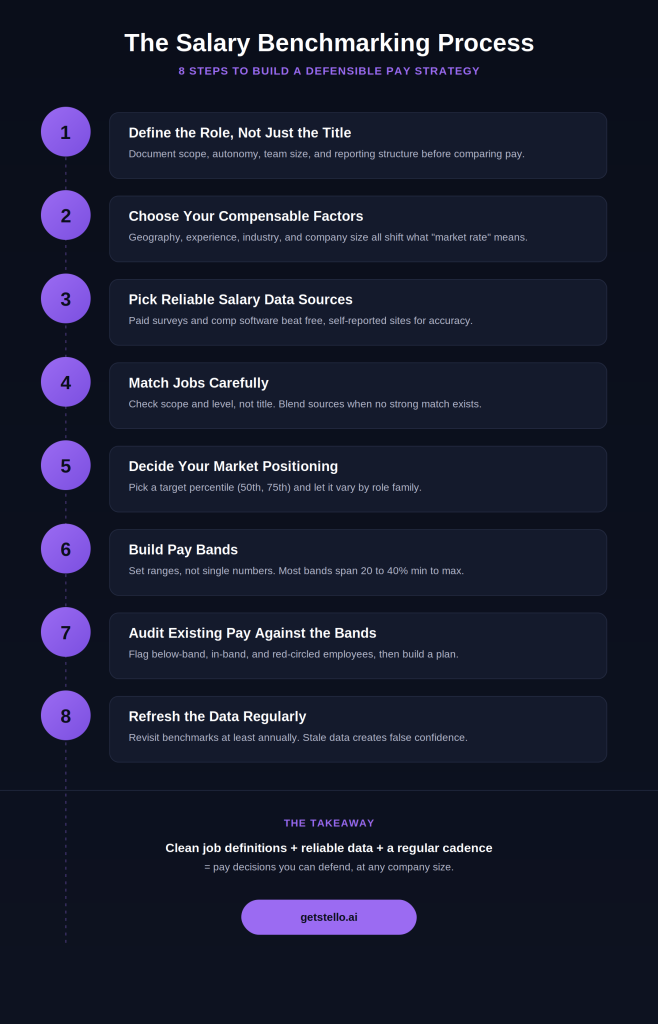
- → Start with job descriptions, not job titles. Titles are inconsistent across companies and lead to bad comparisons.
- → Pick compensable factors upfront: geography, experience level, industry, and company size all shift what “market rate” means.
- → Use reliable data sources. Paid surveys and compensation software beat free, self-reported sites like Glassdoor for accuracy.
- → Match roles carefully, checking scope and reporting level, not just job title, and blend sources for niche roles.
- → Decide your market positioning by percentile (50th for market rate, 75th to compete aggressively), and let it vary by role family.
- → Build pay bands, not single numbers, typically spanning 20 to 40% from minimum to maximum.
- → Audit current employees against the new bands and build a plan for anyone below range.
- → Refresh benchmarks at least once a year. Stale data creates false confidence and quiet retention risk.
- → Avoid the biggest mistakes: wrong peer group, ignoring total comp, treating it as finance-only, and never revisiting the data.
What Salary Benchmarking Actually Means
Salary benchmarking is the process of comparing your company’s pay for a specific role against what the external market pays for similar roles. The goal is to understand where you stand, and then decide, deliberately, where you want to stand.
It is not the same as a pay equity audit, though the two are related. Pay equity looks inward, checking whether people doing similar work inside your company are paid fairly relative to each other. Salary benchmarking looks outward, checking whether your pay is competitive against the market. You need both, but they answer different questions.
Done well, benchmarking gives you three things: a defensible reason for every salary you offer, a tool to catch pay compression and drift before they become retention problems, and a foundation for building pay bands and levels that scale as you hire.
Why Benchmarking Matters More Than Most Teams Realize
A lot of founders and HR leaders treat benchmarking as a nice-to-have, something to get to once the company is bigger. That thinking is backwards. The earlier you build the habit, the cheaper it is to fix mistakes.
Here is what happens without it. You hire your first ten employees at whatever number felt fair in the moment. Two years later, employee three and employee eight have the same title and nearly identical responsibilities, but a 20% pay gap, because the market moved and nobody checked. Now you have a retention risk, a fairness problem, and potentially a legal exposure, all stacked on top of each other.
Benchmarking also protects you on the hiring side. Candidates today have more pay transparency than ever, thanks to salary disclosure laws spreading across states and countries, plus sites like Glassdoor and Levels.fyi putting real numbers in front of every applicant. If your offer is meaningfully below market and you do not know it, you will lose candidates late in the process, after burning weeks of recruiter and hiring manager time.
And internally, benchmarking gives managers a straight answer when someone asks for a raise. Instead of “let me check with finance,” you get “here is where you sit against the 50th percentile for this role in this market, and here is the plan to close the gap if there is one.”
Step 1: Define the Role, Not Just the Title
The biggest mistake in benchmarking is matching on job title alone. Titles are inconsistent across companies. A “Senior Product Manager” at one company might be a “Group Product Manager” at another, doing the exact same job. If you benchmark on title alone, you will pull in bad comparisons and end up with numbers that do not reflect reality.
Instead, start with a job description that captures scope. Write down:
- Core responsibilities and what success looks like in the role
- Level of autonomy (does this person make final decisions, or do they execute someone else’s plan)
- Team size managed, if any
- Years of experience typically required
- Required skills and certifications
- Reporting structure
This becomes your internal job architecture, and it is the foundation everything else is built on. If you skip this step, every later step inherits the error.
Also read: Where AI Belongs in HR Data Work (and Where It Doesn’t)
Step 2: Choose Your Compensable Factors
Once you have defined the role, decide which factors will drive pay differences. The most common ones are:
Geography. Pay for the same role can vary 20 to 40% between markets. A software engineer in San Francisco and one in a smaller metro area are not paid the same, even with identical skills. Decide early whether you will use a single national rate, regional bands, or full geo-differentiated pay. This decision alone shapes your entire compensation philosophy, so make it deliberately, not by accident.
Experience level. Years in the field matter, but so does depth. Someone with eight years of narrow, repetitive experience is not equivalent to someone with five years across varied, high-complexity work. Use experience as a signal, not the only variable.
Industry. Compensation norms differ by industry even for similar job functions. A finance role at a bank pays differently than the same finance role at a seed-stage startup, because of company stage, risk profile, and equity structure.
Company size. Larger companies often pay higher base salaries with more structured bands. Smaller companies may pay less in cash but offer more equity or faster growth paths. Know which one you are competing against, because benchmarking against the wrong comparison set will pull your numbers in the wrong direction.
Step 3: Pick Reliable Salary Data Sources
Your benchmarking is only as good as your data. There are three broad categories of sources, each with tradeoffs.
Paid compensation surveys. Providers like Radford, Mercer, and Willis Towers Watson collect data directly from participating companies, which makes it far more accurate than self-reported data. The tradeoff is cost and complexity. These surveys are typically priced for mid-size and larger companies, and require someone on your team to know how to read and apply the data correctly.
Compensation software platforms. Modern compensation management tools pull in market data, often blending multiple survey sources, and layer it with software that helps you build pay bands, model scenarios, and keep everything updated automatically instead of running a spreadsheet refresh every year. For growing companies, this is often the best balance of accuracy and usability, since it removes the manual work of stitching together multiple data sources by hand.
Free and public sources. Glassdoor, LinkedIn Salary, Levels.fyi, and government labor statistics can be useful for a directional sense of the market, especially for smaller companies just getting started. But self-reported data has real limitations. People misreport titles, inflate numbers, or report total compensation as base salary. Use these as a sanity check, not your primary source.
Whichever source you choose, check three things: sample size for the specific role and location you are benchmarking, how recently the data was collected, and whether the data reflects base salary only or total compensation. Mixing these up is one of the most common benchmarking errors.
Also read: How to Conduct a Pay Equity Analysis: Step-by-Step Framework
Step 4: Match Jobs Carefully
This is where the real work happens. For each internal role, find the closest matching benchmark job from your data source, based on the job description you built in Step 1, not the title.
Read the benchmark job’s summary carefully. Check scope, reporting level, and required experience. If your data source lets you filter by industry, company size, and geography, use every filter available. A rough match will give you a rough number, and that number will shape real pay decisions for real people.
If you cannot find a strong match for a niche or highly specialized role, blend data from two or three adjacent benchmark jobs rather than forcing a poor single match. Document your reasoning so future you, or whoever inherits this work, understands why the number looks the way it does.
Step 5: Decide Your Market Positioning
Once you have market data for each role, you need to decide where you want to sit relative to it. This is usually expressed as a percentile.
- 50th percentile (median): You pay in line with the market. Common for companies that are not trying to win purely on cash compensation, often because they compete on equity, mission, flexibility, or growth opportunity.
- 75th percentile: You are paying above market to attract and retain top talent aggressively. Common in competitive fields like engineering and AI, or for roles you consider mission-critical.
- 25th to 40th percentile: Below-market cash, usually paired with something else, like strong equity upside, exceptional benefits, or a clear growth path. Riskier for retention if the tradeoff is not communicated clearly.
Your positioning does not have to be uniform across the company. Many companies benchmark differently by role family. Engineering might sit at the 75th percentile because the talent market is brutally competitive, while administrative roles sit at the 50th. What matters is that the decision is intentional and consistent, not that every role gets the same treatment.
Step 6: Build Pay Bands
With benchmark data and a positioning strategy in hand, build salary ranges, not single numbers, for each role. A typical band might run from 80% to 120% of your target market rate, giving room for experience differences within the same role without requiring a new benchmark every time someone gets a raise.
Keep bands wide enough to allow for growth and negotiation, but not so wide that they lose meaning. A band that spans $80,000 to $180,000 for one job title tells candidates and employees almost nothing useful. As a general guideline, most companies land somewhere between 20 to 40% spread from minimum to maximum, though this varies by level, with senior and executive bands often running wider than entry-level ones.
Step 7: Audit Existing Pay Against the New Bands
Once your bands exist, run every current employee’s salary against them. You will typically find three groups.
People below the band need a plan, whether that is an immediate adjustment, a phased increase over one or two cycles, or a documented reason tied to a formal performance improvement process. People within the band are fine, though you should still map where they sit, since someone at the very bottom of a wide band may be a retention risk even without a technical policy violation. People above the band, sometimes called “red-circled” employees, usually keep their current pay but do not get further base increases until the market or band catches up.
This audit is often uncomfortable, because it surfaces gaps that have been invisible for years. That discomfort is the point. Better to find the gap yourself than have an employee find it first.
Step 8: Refresh the Data Regularly
Salary benchmarking is not a one-time project. Markets move, sometimes fast, especially in high-demand fields like software engineering, data science, and AI roles, where compensation can shift meaningfully within a single year.
Most companies refresh benchmarks annually at minimum, and some review high-velocity roles twice a year. Build this into your compensation calendar the same way you would budget planning or performance review cycles, so it does not quietly slip for two or three years until someone notices pay has fallen behind.
Common Mistakes to Avoid
Benchmarking against the wrong peer group. Comparing your seed-stage startup against enterprise compensation data will produce numbers you cannot actually afford, and comparing an enterprise role against startup data will leave you underpaying and losing candidates.
Ignoring total compensation. Base salary is only part of the picture. If your benchmark data reflects total compensation including bonus and equity, but you are only comparing it to your base salary offer, you will misjudge your competitiveness in either direction.
Treating benchmarking as a finance-only exercise. The best benchmarking processes involve HR, finance, and hiring managers together. Hiring managers know the real scope of the work being done day to day. Finance knows what the company can sustain. HR knows the policy and fairness implications. Leaving any one of them out produces a number that looks right on paper but does not hold up in practice.
Setting it and forgetting it. Stale benchmarks are almost worse than no benchmarks, because they create false confidence. A pay band that was accurate two years ago can quietly become a retention liability today if nobody has checked it since.
Bringing It Together
Salary benchmarking is not about chasing the highest number in every category. It is about making a deliberate, documented, defensible decision about where your company sits in the market, and building the systems to keep that decision accurate as both your company and the market change.
Done right, it protects you from three things at once: losing candidates to competitors who pay smarter, losing employees to pay drift nobody caught in time, and losing credibility when someone finally asks how a number was set. Start with clean job definitions, use reliable data, match roles carefully, and revisit the work on a regular cadence. That is the whole system, and it scales from a ten-person team to a ten-thousand-person company without changing shape.