Every HR leader is being asked the same question right now, from the boardroom or from their own team: how much should we trust AI with our people data?
The honest answer is not “a lot” or “a little.” It depends entirely on what kind of work you’re handing over. AI has become genuinely excellent at the mechanical middle of HR data work: pulling numbers, building charts, spotting outliers, formatting reports. It is still nowhere close to replacing the judgment that turns a data point into a fair, defensible decision about a real person’s pay or career.
Getting that line right matters more than it used to. Here’s where AI actually belongs in HR data work, where it doesn’t, and why the distinction is becoming a legal issue as much as a strategic one.
TL;DR
- AI belongs in HR data work that ends in a chart, a report, a flag, or a first-pass recommendation, not in a final decision about someone’s pay or job.
- It’s genuinely good at reporting and visualization, market data aggregation, pay equity anomaly detection, scenario modeling, and summarizing data for non-specialist audiences.
- Compensation professionals themselves rank over-reliance on AI as their top AI-related risk, ahead of data privacy and bias, per Payscale’s 2026 report.
- Regulation is catching up fast: Illinois requires bias avoidance and notification, Colorado’s AI Act (mid-2026) treats employment AI as high-risk, and a California court recently let AI hiring discrimination claims proceed.
- AI benchmarks can show a number the business can’t actually support, because AI doesn’t see internal budget, equity structure, or role scope. That gap is why a human still has to make the final call.
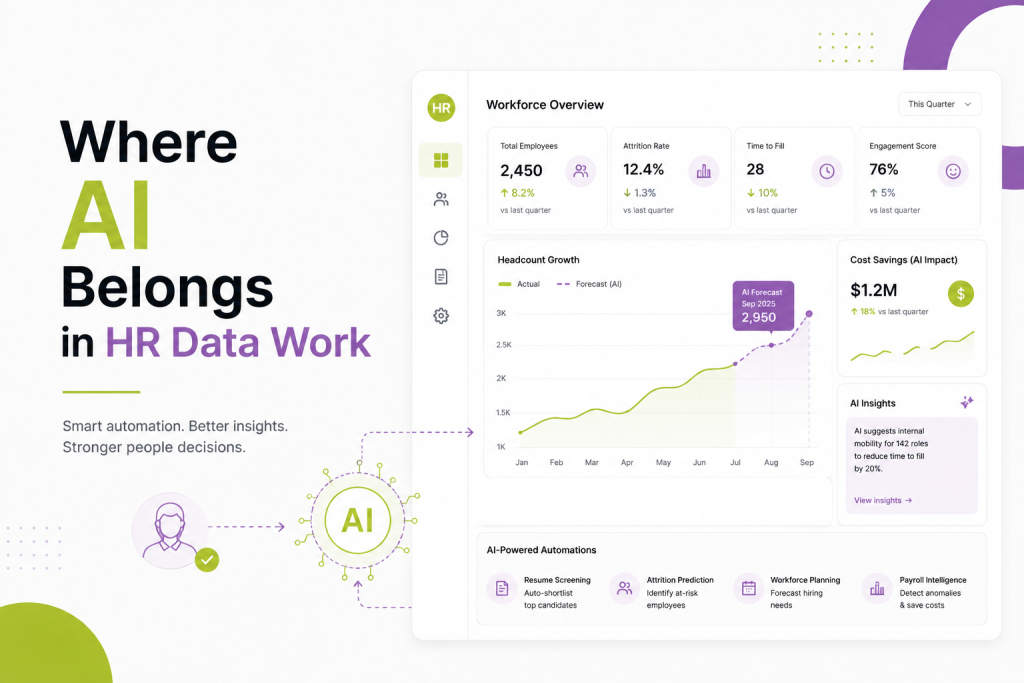
- Stello AI’s Analytics Agent is built for the first category: it turns plain-English questions into presentation-ready charts in seconds, so comp teams get the data faster without handing over the decision.
The problem AI is genuinely solving: turning data into something usable
HR teams don’t have a data shortage. Most have the opposite problem: comp bands, headcount, budget, and performance data sitting in systems that were never built to talk to each other, and no fast way to turn that into something a CFO or a board can actually look at.
That gap, the hours lost to exporting, charting, and formatting instead of analyzing, is exactly what we built the Stello AI Analytics Agent to close.
This is the category of task AI is unambiguously good at: repetitive, rules-based, high-volume, and low-stakes on its own. Nobody’s rights are affected by which chart type best represents bonus spend by region. That’s exactly why it’s safe to hand fully to a machine, and why doing so frees up hours that used to disappear into formatting instead of thinking.
Where the research says AI clearly belongs
Beyond visualization, a few areas of HR data work are consistently where AI adds real value without much controversy:
Aggregating and refreshing market data. Traditional comp benchmarking relied on annual surveys that went stale within months. AI-assisted job matching and continuous data pulls mean the gap between “we need to price this role” and “here’s a defensible range” is now measured in minutes rather than days.
Flagging anomalies before they become problems. AI can scan thousands of pay records to surface potential equity gaps, pay compression, or policy-inconsistent decisions well before they show up in an audit or a lawsuit. Analysts still investigate and decide what to do about a flag. The AI’s job is just noticing it faster than a human scanning a spreadsheet would.
Modeling scenarios. Testing five different merit budget scenarios by hand takes an afternoon. AI can run the same models in minutes, which means comp teams can actually iterate on planning instead of committing to the first version that fits the budget.
Summarizing for non-specialist audiences. Turning a market pricing report into a plain-language brief for a hiring manager, or a comp update into something a board member can skim in two minutes, is a task AI handles well because the underlying facts don’t change, only the framing does.
Payscale’s 2026 Compensation Best Practices Report is a useful gut check here: compensation professionals themselves rank over-reliance on AI, at the cost of human judgment and context, as their single biggest AI risk, ahead of both data privacy and bias concerns. The people closest to this work already know where the edge of comfort sits.
Where AI does not belong: the final call
The line isn’t about task complexity. It’s about consequence. The moment an output stops being a chart or a data point and starts being a decision about a specific person’s pay, promotion, or continued employment, AI needs to move from driver to input.
There’s real regulatory weight behind this now, not just best-practice advice. Several jurisdictions are treating AI-assisted employment decisions as employment decisions, full stop, meaning employers stay accountable for the outcome no matter how the recommendation was generated:
- Illinois now requires employers to avoid AI-driven bias against protected classes and to notify candidates when AI is used in employment decisions.
- Colorado’s AI Act, taking effect mid-2026, classifies employment-related AI systems as high-risk and imposes specific governance obligations.
- A California federal court recently allowed discrimination claims against an AI-powered hiring tool to proceed past a motion to dismiss, a sign that courts are willing to scrutinize these systems closely rather than treat the algorithm as a neutral bystander.
None of this means AI can’t touch high-stakes decisions at all. It means AI can surface a recommendation, but a person still has to sign off, someone with context the system doesn’t have:
- A hiring freeze
- A retention risk
- An internal equity concern
- A manager relationship
There’s a practical reason for this too, not just a legal one. AI benchmarks are built from inconsistent, often outdated market data, and that produces real variability even for the same role. An employee might see an AI-generated benchmark of $95,000 for their position while the business can genuinely only support $82,000. That gap isn’t a system error, it’s just compensation operating inside budgets, internal equity structures, and role scope that the AI simply doesn’t see. It’s the difference between data and a decision.
Also read: How to Conduct a Pay Equity Analysis: Step-by-Step Framework
A working rule of thumb
The simplest version of the line, based on everything above: AI should own anything that ends in a chart, a report, a flag, or a first-pass recommendation. A person should own anything that ends in a number attached to someone’s paycheck or a decision about their job.
That’s also, not coincidentally, the design principle behind the Analytics Agent. It answers “how has comp changed over the last three years” with a clean visual in seconds. It does not decide what to do about what that chart shows. That part still belongs to the comp team, the way it always has.
AI didn’t remove judgment from HR data work. It just cleared away everything that was never judgment to begin with, so the people whose job it is to make the hard calls have more time to actually make them.
Also read: AI Comp Management for Startups: What’s Different Under 200 Employees
FAQs-
Does AI replace compensation professionals?
No. AI automates the data-heavy, mechanical parts of comp work, like benchmarking, charting, and scenario modeling, but final pay decisions still require human judgment on budget, internal equity, and business context the AI can’t see.
Is it legal to use AI in employment decisions?
Yes, but it’s regulated. Illinois requires bias avoidance and candidate notification when AI is used. Colorado’s AI Act (mid-2026) classifies employment AI as high-risk with governance requirements. Employers stay accountable for outcomes even when a recommendation came from an algorithm.
What HR tasks is AI actually good at?
Reporting and visualization, market data aggregation, pay equity anomaly detection, scenario modeling, and summarizing data for non-specialist audiences like managers or board members. These are high-volume, rules-based tasks with low individual stakes.
What HR tasks should stay human-led?
Anything that ends in a decision about a specific person: final pay amounts, promotions, terminations, or offer approvals. AI can inform these with data, but a person needs to apply context the system doesn’t have before signing off.
Why do AI salary benchmarks sometimes not match what a company can pay?
AI benchmarks are built from market data that can be inconsistent or outdated, so the same role can show real variability across sources. A company’s actual number also has to fit inside its budget, internal equity structure, and role scope, none of which the AI can see.
What is the risk of over-relying on AI in compensation?
Compensation professionals themselves rank over-reliance on AI, at the cost of human judgment and context, as their top AI-related risk, ahead of both data privacy and bias concerns, according to Payscale’s 2026 Compensation Best Practices Report.
How does the Stello AI Analytics Agent fit into this?
It’s built for the first category, not the second. It turns plain-English questions into presentation-ready charts in seconds, cutting the reporting time HR teams currently lose to manual chart building. It doesn’t make pay decisions. It gives comp teams faster access to the data they need to make them.